

Comfortable Scrubs for Home Health Aides: A 2026 Guide
Table of Contents
- Why Comfortable Scrubs Matter for Home Health Aides
- Key Features of Comfortable Scrubs for Home Health Work
- Best Scrubs for 12 Hour Shifts: What to Look For
- How to Choose the Right Scrub Fabric for Home Health
- Scrub Care and Maintenance Tips for Longevity
- Top Comfortable Scrub Styles for Home Health Aides
- Finding Your Perfect Fit: Size and Mobility Considerations
- Conclusion
Last Updated: August 9, 2026
Why Comfortable Scrubs Matter for Home Health Aides
Home health aides face unique physical demands: moving between patient homes, lifting and transferring clients, bending repeatedly, and working 12-hour shifts in unpredictable environments. The right comfortable scrubs for home health aides become essential gear, not just a uniform. At love2wear_scrubs, we understand that what works in a climate-controlled hospital often fails in someone's living room.
By hour eight of your shift, poorly fitting or restrictive fabric affects your movement, confidence, and ability to provide safe care. Seams that ride up, pockets that tear, or fabric that doesn't breathe drain your energy. Scrubs engineered for mobility, durability, and moisture management let you focus entirely on your clients.
Home health work also exposes your uniform to different hazards than clinical settings. You're sitting on client furniture, kneeling on floors, and sometimes working in homes with pets or dust. Fabric that resists stains, wrinkles easily, and survives frequent washing becomes a practical advantage.
Key Features of Comfortable Scrubs for Home Health Work
When evaluating comfortable scrubs for home health aides, focus on specific performance characteristics that directly impact your ability to work safely and comfortably. Generic scrubs designed for stationary clinical roles fall short when your job requires constant movement, flexibility, and durability.
Breathable and Moisture-Wicking Fabrics
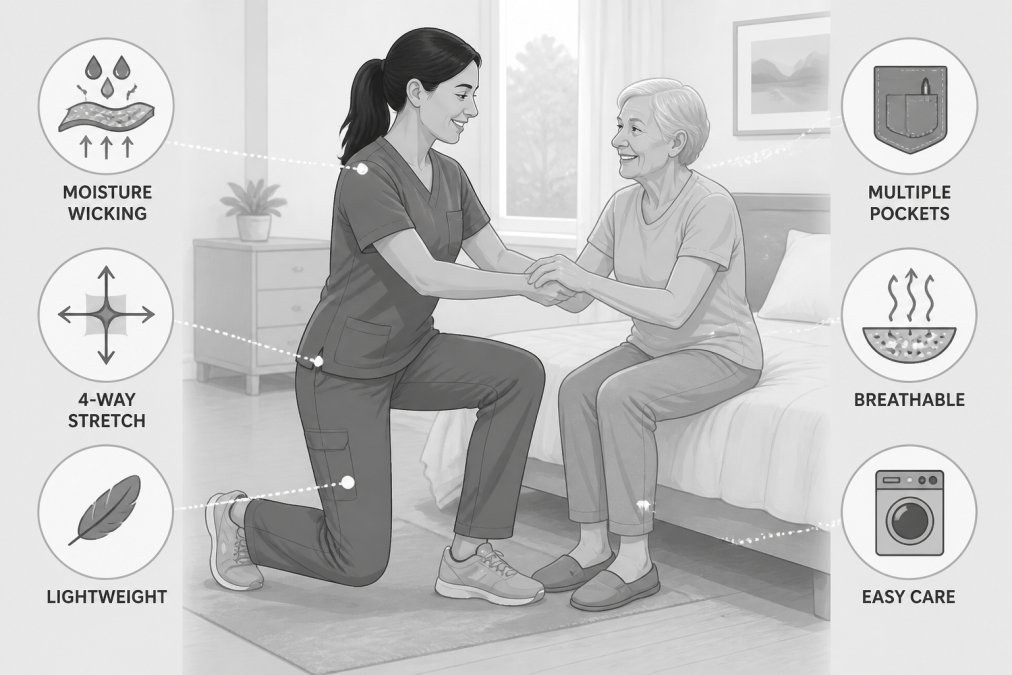
Breathable, moisture-wicking fabric keeps you dry throughout extended shifts, preventing the clammy feeling that builds up during physical exertion. Home health aides often work in homes without consistent air conditioning, making fabric choice critical to comfort.
Look for synthetic blends that actively pull moisture away from your skin. Polyester-rayon blends with spandex create the ideal balance: they wick sweat efficiently while maintaining softness. Materials like FIGS' FIONx™ fabric and similar performance blends are engineered specifically for this purpose.
The practical difference shows up around hour six of your shift. With moisture-wicking fabric, you remain dry and comfortable. Without it, fabric clings to your body, reducing your range of motion when you need it most.
Four-Way Stretch and Range of Motion
Four-way stretch fabric transforms how scrubs function during active work. Home health aides bend, squat, reach overhead, and twist constantly. Fabric that only stretches side-to-side restricts movement when you need it most.
True four-way stretch incorporates spandex content (typically 3-5%) that allows fabric to move with your body in every direction. This becomes especially important when transferring clients or performing personal care tasks requiring full range of motion.
Brands like Jaanuu and Grey's Anatomy specifically engineer their scrubs with spandex-stretch technology. The difference is noticeable immediately: restricted movement feels like wearing a uniform one size too small, while proper stretch feels like the fabric isn't there at all.
Functional Pocket Design and Utility
Functional pocket design separates scrubs built for home health from generic medical apparel. You need deep, reinforced pockets that hold your phone, scissors, stethoscope, and other tools without tearing or shifting.
Home health aides typically carry more items than hospital nurses: supplies for multiple clients, personal items for traveling between homes, and communication devices. Shallow pockets force you to carry items in your hands, reducing your mobility and efficiency.
Look for reinforced pocket seams, double-stitching at stress points, and placement that doesn't interfere with movement. Pockets positioned on the thigh or cargo-style offer more capacity than traditional front pockets. Love2wear_scrubs incorporates durable pocket construction designed for the demands of active home health work.
Best Scrubs for 12 Hour Shifts: What to Look For
A 12-hour shift demands scrubs engineered for endurance. By hour 10, seams that weren't properly constructed begin to separate, elastic waistbands lose their shape, and fabric starts showing wear. The right scrubs combine durability with comfort features that prevent fatigue.
Durability and Reinforced Seams
Durability means reinforced seams, quality thread, and fabric that maintains its integrity through repeated washing and physical stress. Home health aides wash their scrubs frequently, often multiple times per week, making fabric longevity essential.
Reinforced seams use double or triple stitching at high-stress points: pocket corners, armholes, crotch seams, and hem lines. Single-stitched seams fail relatively quickly under stress and washing. Brands like Cherokee Workwear Revolution and Adar Uniforms specifically engineer reinforced seams for durability.
After 50-75 washes, quality scrubs maintain their fit and appearance, while budget options begin showing wear: faded color, loose seams, and loss of stretch. Durability comes from construction quality, seam reinforcement, and fabric engineering, not weight.
Ergonomic Fit and Professional Appearance
Ergonomic fit means scrubs that accommodate your actual body shape and movement patterns. Home health settings require professional appearance, but fit must prioritize function.
Look for tapered legs that don't bunch at ankles, waistbands that stay in place during bending, and sleeve length that doesn't interfere with patient care. Modern scrub styles, particularly jogger-style pants and fitted tops, offer ergonomic advantages over classic cuts. Joggers provide a tapered ankle that prevents fabric from dragging on floors, while fitted tops allow full range of motion without excess fabric.
Scrubs that fit well look intentional and polished, building client trust and your own confidence. Love2wear_scrubs' modern fit design provides scrubs that look professional while accommodating the movement demands of home health work.
How to Choose the Right Scrub Fabric for Home Health
Fabric choice determines how scrubs perform across temperature, moisture, and durability.
Wrinkle-Resistant and Easy-Care Materials
Wrinkle-resistant, easy-care fabric simplifies your life when managing multiple responsibilities. Fabric that requires minimal ironing and maintains appearance through washing saves time and reduces stress.
Most modern scrub fabrics incorporate wrinkle-resistant finishes using polyester blends. Polyester-rayon-spandex blends (typically 76% polyester, 21% rayon, 3% spandex) offer the best combination: soft feel with natural wrinkle resistance.
Antimicrobial finishes, available on many quality scrubs, actively resist odor and bacteria growth. This becomes practical when you're in multiple client homes and can't wash scrubs immediately after each shift. Look for fabric rated for warm water washing and low heat drying without loss of stretch or shape.
Stain-Resistant and Antimicrobial Options
Stain-resistant finishes protect fabric from the inevitable spills and contact that occur in home settings. Unlike hospital environments, home health work exposes scrubs to food, pet accidents, and various household substances.
Stain-resistant treatments chemically treat fabric fibers to repel liquids and prevent staining. Quality finishes survive multiple washings without degrading. Antimicrobial properties actively inhibit bacterial and fungal growth on fabric, which matters when moving between multiple client homes.
Scrub Care and Maintenance Tips for Longevity
Proper care extends scrub lifespan significantly. Quality pairs last 12-18 months of regular use with correct maintenance, while poor care reduces that to 4-6 months.
Wash scrubs in warm water (not hot) using gentle detergent without bleach. Hot water breaks down elastic fibers and causes premature fading. Dry on low heat or air dry to preserve stretch and shape. Separate scrubs from other clothing to prevent color bleeding and lint transfer.
Inspect seams and pockets regularly for early signs of wear. Avoid fabric softeners and dryer sheets, which reduce moisture-wicking properties. If you need softness, use white vinegar in the rinse cycle.
Top Comfortable Scrub Styles for Home Health Aides
Scrub style preferences vary by personal comfort and work environment.
Jogger vs. Classic Scrub Styles
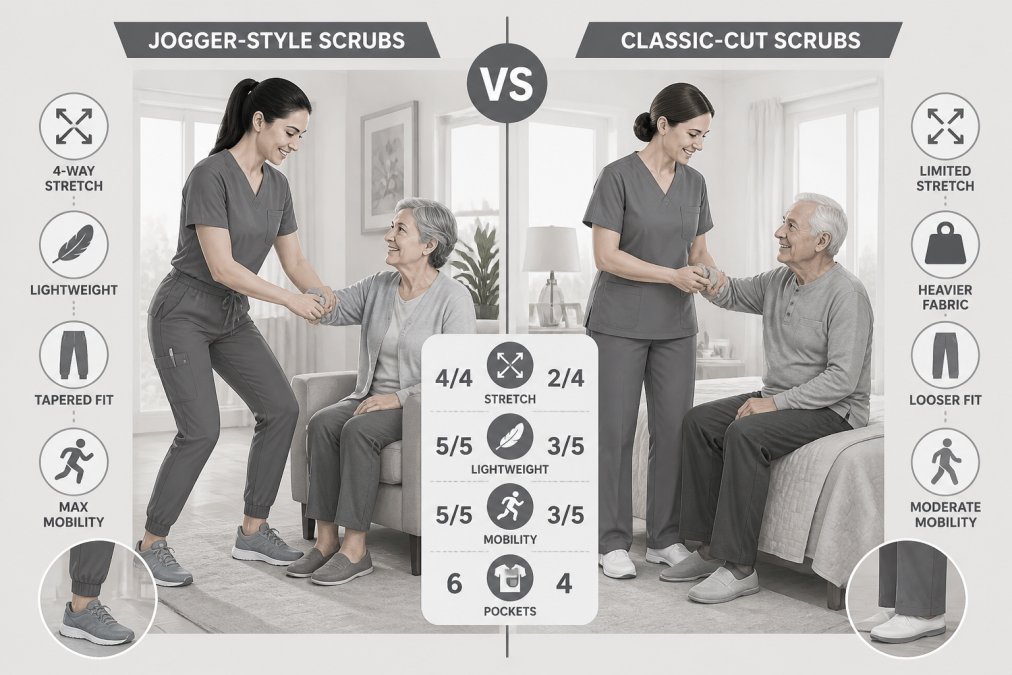
Jogger-style scrubs have become increasingly popular among home health aides because they combine professional appearance with functional design. Joggers feature tapered legs with elastic cuffs at the ankle.
The practical advantages are significant. Tapered legs prevent fabric from dragging on floors or getting caught on furniture. Elastic cuffs keep the pant leg in place during movement without requiring constant adjustment. The tapered design also creates a more modern, polished appearance.
Classic scrub styles feature straight legs and loose fits throughout. They offer more room in the thigh and calf, which some practitioners prefer. However, loose fabric can get in the way during patient care and requires more adjustment throughout your shift.
Joggers work better for most home health aides because they offer better mobility and fewer adjustments needed during a shift.
Layering Strategies for Home Health Environments
Home health work often requires layering because you move between climate-controlled homes, unheated spaces, and vehicles. Scrubs that accommodate layering without becoming bulky become essential.
Fitted scrub tops allow you to layer a long-sleeve undershirt or light jacket underneath without excess bulk. Look for scrub tops with a tapered cut that fits close to your body while maintaining range of motion.
Lighter-weight scrubs layer better than heavier materials, which create bulk and restrict movement. Quality moisture-wicking fabrics work better as base layers than cotton, which absorbs sweat and becomes uncomfortable under additional clothing.
Some home health aides keep two weights of scrubs: lighter options for warm months and standard-weight for cooler seasons.
Finding Your Perfect Fit: Size and Mobility Considerations
Proper fit determines whether scrubs enhance or hinder your ability to work safely and comfortably. Scrub sizing varies significantly between brands, so trying scrubs before committing to multiple pairs matters.
When evaluating fit, perform the movements your job requires: squat fully, reach overhead, bend at the waist, and simulate transferring a patient. Scrubs that fit well when standing often restrict movement during these essential motions.
Waistband placement and elasticity matter significantly. A waistband that sits too low or rides up during movement creates constant adjustment and discomfort. Inseam length affects both appearance and function. Pants that are too long bunch at ankles, creating a tripping hazard. Pants that are too short expose your socks and restrict ankle mobility.
Brands like Jaanuu, Adar, and love2wear_scrubs offer extended size ranges (typically XS through 3XL or larger) to accommodate different body types. Start with one pair from a brand you're considering, evaluate fit through actual work, and only then commit to additional pairs.
Choosing comfortable scrubs for home health aides requires balancing comfort, durability, and professional appearance in ways that hospital-focused scrub designs often miss. Your uniform directly impacts your ability to provide safe, confident care throughout long, physically demanding shifts. Love2wear_scrubs addresses these specific needs with modern-fit designs engineered for mobility, breathable fabrics that manage moisture and temperature, and construction quality that survives the demands of home health work. Explore love2wear_scrubs' collection to find scrubs that keep you comfortable, supported, and professional through every home health shift.
Frequently Asked Questions
Can home health aides wear scrubs?
Yes, home health aides absolutely wear scrubs. In fact, scrubs are the standard uniform for home health professionals. They provide the comfort, mobility, and professional appearance needed for patient care in home environments. When choosing scrubs as a home health aide, prioritize moisture-wicking, four-way stretch, and durable fabrics that can handle frequent washing and the physical demands of home-based patient care.
What makes comfortable scrubs suitable for 12-hour shifts?
The best scrubs for 12 hour shifts combine breathable, moisture-wicking fabric with four-way stretch to support constant movement and bending. Look for reinforced seams that won't fail after months of wear, deep functional pockets that won't rip under weight, and an ergonomic fit that moves with your body without riding up or shifting. Wrinkle-resistant materials also help maintain a professional appearance throughout your entire shift without additional ironing.
How do I choose the right scrub fabric for home health work?
Choose scrub fabrics based on three criteria: breathability (moisture-wicking polyester blends or rayon mixes), durability (look for reinforced seams and high-performance materials), and easy care (wrinkle-resistant and stain-resistant options). Home health aides benefit from antimicrobial or fluid-resistant fabrics that can handle spills and frequent laundering. Test the stretch, four-way stretch fabrics offer superior range of motion during patient transfers and bending movements.
What's the best way to care for scrubs to make them last longer?
Wash scrubs in cold water with mild detergent to preserve fabric integrity and prevent fading. Avoid bleach unless the label permits it, and skip fabric softeners which can reduce moisture-wicking properties. Dry on low heat or air dry to prevent shrinkage and extend the life of elastic waistbands. Repair small seam issues immediately to prevent larger tears. Proper care extends the lifespan of durable scrubs significantly, protecting your investment over months of regular use.
This article was written using GrandRanker