

Durable Scrubs for Emergency Rooms: What Actually Lasts
Table of Contents
- What Makes Durable Scrubs for Emergency Rooms Different
- Fabric Technology That Survives High-Stress Environments
- Best Nursing Scrubs That Last Through Industrial Washing
- Stain-Resistant Scrubs for ER Nurses: Fade and Shrink Prevention
- How to Choose Scrubs for Emergency Medicine: Pocket Placement and Ergonomic Design
- Why Reinforced Stitching and Utility Pockets Matter in Trauma Bays
- Conclusion
Last Updated: August 27, 2026
What Makes Durable Scrubs for Emergency Rooms Different
Emergency medicine demands more from your clothing than almost any other profession. You're moving constantly, bending in ways that stress seams, and working shifts long enough that comfort becomes a survival necessity. Durable scrubs for emergency rooms are engineered specifically for the trauma bay environment.
Standard scrubs use cotton blends that breathe well but lose integrity under repeated stress and industrial washing. Emergency-grade scrubs rely on polyester-dominant blends, frequently combined with spandex, that maintain their structure through hundreds of wash cycles. A nurse working a 12-hour shift in the ER doesn't have time to babysit clothing that's coming apart at the seams.
What separates durable scrubs for emergency rooms is the combination of three elements: fabric technology that resists both physical stress and chemical exposure, construction methods that anticipate where tears actually happen, and pocket placement designed around what you're actually carrying. A stethoscope, trauma scissors, phone, and pens create different stress points than standard scrub pockets were designed to hold.
Love2wear Scrubs has built their entire product line around this reality. Their approach focuses on polyester-spandex blends that deliver moisture-wicking performance while maintaining shape through aggressive industrial laundering.
Fabric Technology That Survives High-Stress Environments
The fabric you choose determines whether your scrubs last three months or three years. Emergency departments expose clothing to repeated bending and stretching, exposure to blood and bodily fluids, high-temperature industrial washing, and constant contact with equipment edges.
Polyester-spandex blends have become the industry standard for emergency medicine because they address all these stressors simultaneously. Polyester provides durability and maintains color through repeated washing. Spandex (typically 5-10% of the blend) adds elasticity that allows the fabric to stretch without tearing, then return to its original shape (peer-reviewed research). This combination is fundamentally different from cotton-based scrubs, which lose elasticity over time and develop permanent wrinkles that become breeding grounds for bacteria.
Polyester-Spandex Blends and Four-Way Stretch
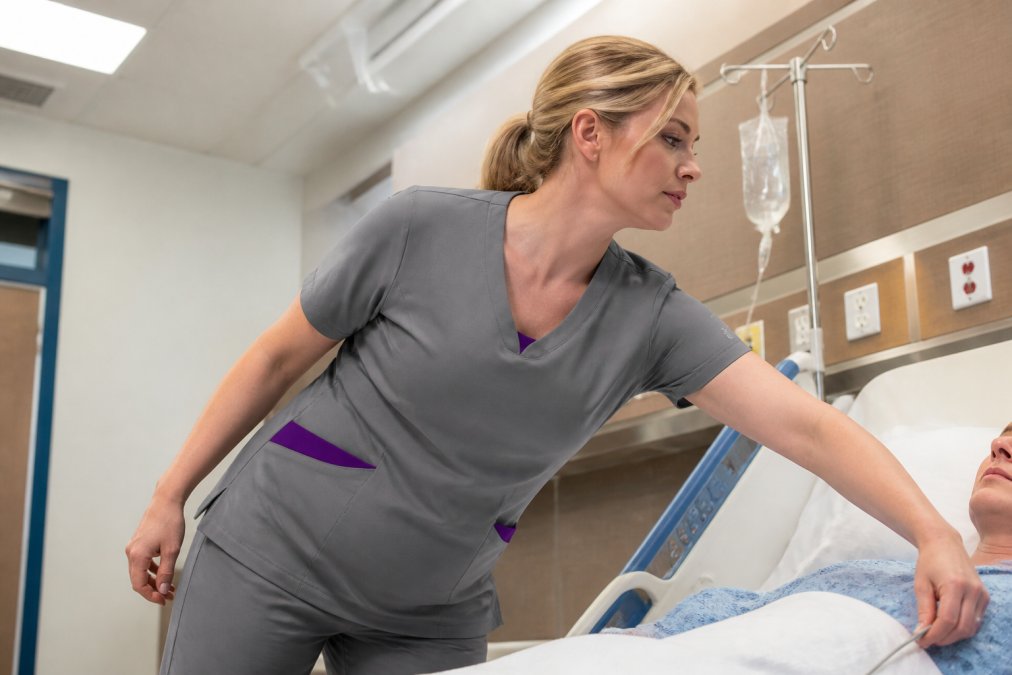
Four-way stretch fabric moves in all directions: up and down, side to side, and diagonally. This matters in the ER because your movements aren't linear. You're reaching overhead for equipment, bending sideways to access a patient's arm, and rotating your torso while keeping your hands steady. Standard two-way stretch creates tension points when you move diagonally, leading to seam stress and failure.
The Four-Way-Stretch Scrub Set from love2wear_scrubs uses polyester-spandex construction specifically designed for this range of motion. When fabric can move with your body instead of against it, seams experience less stress and the garment lasts longer. Four-way stretch also maintains its performance through industrial laundering, keeping scrubs fitting properly after months of use.

Fluid Resistance and Decontamination Standards
Emergency departments require scrubs that repel blood, saline, and other bodily fluids. Fabric that absorbs fluid becomes a vector for pathogen transmission and requires immediate changing and laundering.
Water-impervious scrubs use tightly woven polyester construction that resists fluid penetration. Liquids bead on the surface rather than soaking through, giving you time to notice exposure and take action. Industrial decontamination standards for healthcare facilities involve washing at 160-180°F with heavy-duty detergent and bleach (osha.gov). Scrubs designed for this environment maintain their fluid-resistance properties through these cycles.
Best Nursing Scrubs That Last Through Industrial Washing
Industrial laundering is the real test of scrub durability. Hospital laundry services wash at temperatures and with chemicals that would damage consumer clothing. The question isn't whether your scrubs can survive one washing, it's whether they'll still fit properly after 100 washings.
The best nursing scrubs that last are constructed with reinforced seams at stress points. Double-stitching or triple-stitching at armholes, side seams, and pocket tops prevents the gradual seam separation that happens when fabric stretches and contracts repeatedly under heat and moisture.
Love2wear Scrubs' New Stretch Quick-drying Medical Scrubs start at $46.10 and deliver the construction quality needed for hospital laundry cycles. The polyester fiber composition resists heat damage, and the moisture-wicking function means they dry faster after washing, reducing time in the dryer where heat damage accelerates.

Shrinkage is a common problem with scrubs that haven't been properly pre-shrunk. Quality manufacturers pre-shrink fabric before cutting and sewing, so what you buy is what you keep. The Stretchy, Quick-drying Scrubs from love2wear_scrubs are priced at $43.89 and feature polyester construction with specific attention to moisture-wicking performance, addressing the two main failure points for scrubs in industrial laundry: shrinkage and seam separation.
Stain-Resistant Scrubs for ER Nurses: Fade and Shrink Prevention
Stain-resistant scrubs for ER nurses need to handle visible stains and the fading that happens when you're constantly treating stains. A scrub that shows every mark becomes demoralizing after a few shifts.
Fade resistance comes from dye selection and fabric composition. Polyester holds color better than cotton because the dye bonds more permanently to synthetic fibers. Stain resistance works by making stains easier to remove and less likely to set permanently. High-quality polyester fabrics resist stain penetration better than cotton, giving you a window of time to treat the stain before it sets.
The Moisture Wicking Scrub Set at $37.65 uses polyester fiber construction that resists both fade and stain setting. The color options available (pink, lake blue, wine red, sapphire blue, sky blue, purple, dark green, medium gray, black, navy blue) are engineered to maintain their appearance through repeated washing and bleach exposure.

Shrink prevention involves pre-shrinking the fabric and using construction methods that account for residual shrinkage. Quality manufacturers minimize it to less than 2%, while cheaper alternatives might shrink 5-10%.
How to Choose Scrubs for Emergency Medicine: Pocket Placement and Ergonomic Design
Pocket placement in emergency medicine scrubs is not a cosmetic decision. Where your pockets sit determines whether you can access your tools quickly, whether they stay in place during movement, and whether weight distribution causes back strain during a 12-hour shift.
Standard scrubs place pockets for appearance. Emergency medicine scrubs place pockets for function. A stethoscope needs a pocket deep enough to prevent it from falling out when you bend forward. Trauma scissors need a pocket reinforced enough to handle the weight and sharp edges. Your phone needs a pocket positioned so it doesn't slide down your leg.
Ergonomic design means the garment distributes weight evenly so you're not developing shoulder pain, and it allows full range of motion without the fabric bunching or riding up. The Four-Way-Stretch Scrub Set from love2wear_scrubs addresses this with pocket placement engineered around what nurses actually carry.
Tapered legs in emergency scrubs prevent the pant leg from dragging on the floor when you're moving quickly and reduce the chance of stepping on your own pants when reaching down to work with a patient.
Why Reinforced Stitching and Utility Pockets Matter in Trauma Bays
Reinforced stitching is the difference between scrubs that last and scrubs that fall apart. In a trauma bay, you're moving fast and putting stress on your clothing in ways that normal wear and tear doesn't capture. A single-stitched seam can separate within weeks. Double or triple-stitched seams can handle months of the same abuse.
The stress points in emergency medicine scrubs are predictable: armholes take stress from reaching and lifting, side seams take stress from bending and twisting, and pocket tops take stress from the weight of equipment and repeated motion. Quality manufacturers reinforce all these areas.
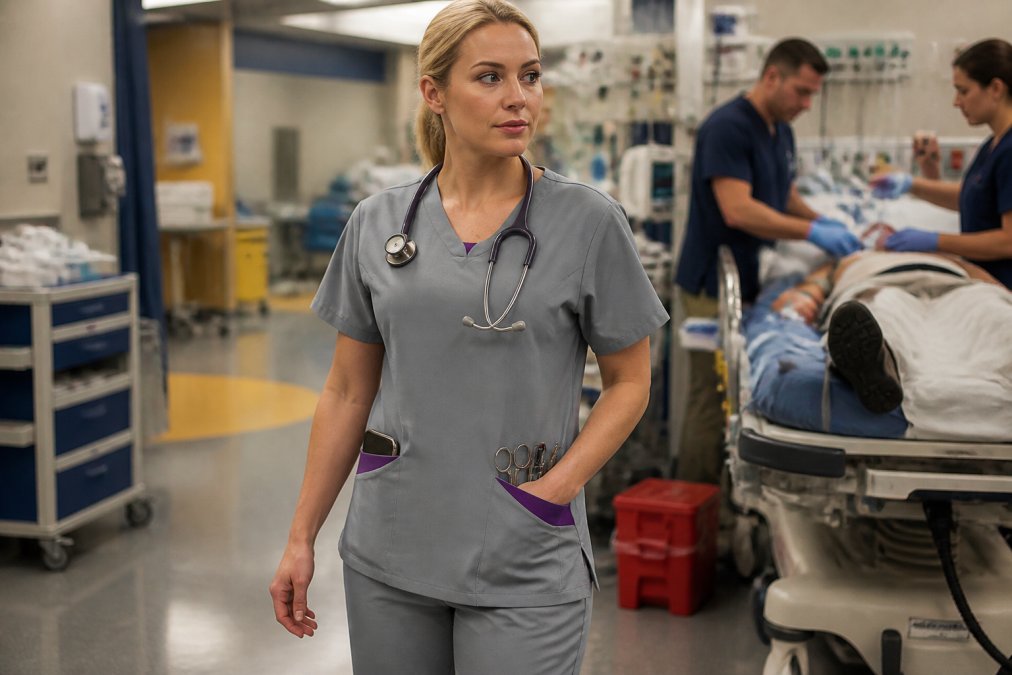
Utility pockets need to be deep enough to hold tools without them shifting during movement and positioned so you can access them without looking down. The Water-impervious Scrubs from love2wear_scrubs are designed specifically for environments where fluid exposure is constant. The reinforced pocket construction handles the weight of trauma tools, and the water-impervious fabric means that if blood or saline gets on your scrubs, it doesn't soak through to your underclothing.
Multiple pockets matter in emergency medicine because you're carrying multiple items. A single-pocket design forces you to choose what you carry. Multiple utility pockets let you organize your tools so weight is distributed rather than concentrated in one area. The Scrub Set Short Sleeve Quick Drying at $41.47 includes reinforced stitching as standard.
Choosing durable scrubs for emergency rooms means prioritizing fabric technology, construction quality, and design features that address the actual demands of emergency medicine. Love2wear Scrubs delivers all three without premium pricing. The Four-Way-Stretch Scrub Set at $50.40 combines four-way stretch fabric with reinforced stitching and utility pocket placement designed for trauma environments. For budget-conscious teams, the New Stretch Quick-drying Medical Scrubs at $46.10 provide the same durability and moisture-wicking performance at a lower price point.
Quality durable scrubs for emergency rooms survive industrial laundering and still fit properly and function as designed. Get started with love2wear_scrubs and experience scrubs that actually hold up to emergency medicine's demands.
Frequently Asked Questions
What fabric features make durable scrubs for emergency rooms last longer?
The best durable scrubs for emergency rooms combine polyester-spandex blends (typically 95% polyester, 5% spandex) with four-way stretch technology. This combination resists shrinking and fading through industrial laundering cycles while maintaining shape after repeated washing. Reinforced stitching at seams, pocket edges, and stress points prevents tearing when carrying trauma tools and equipment during 12-hour shifts.
How do stain-resistant scrubs for ER nurses prevent permanent discoloration?
Stain-resistant scrubs for ER nurses use polyester-based fabrics that resist fluid absorption and are treated to repel bodily fluids and common hospital stains. The synthetic fiber composition prevents dyes from setting permanently compared to cotton blends. Moisture-wicking technology moves fluids away from the fabric surface, reducing contact time and stain penetration. Regular machine washing at hospital-grade temperatures won't fade or damage polyester-spandex blends like it does natural fibers.
When choosing scrubs for emergency medicine, what pocket configuration actually works?
When choosing scrubs for emergency medicine, prioritize deep utility pockets with reinforced stitching and angled placement at hip level for quick access without bending. Multiple pockets (at least 4-6 across top and pants) let you carry a phone, scissors, stethoscope, and trauma shears without overloading one pocket. Elastic-lined or gusseted pockets distribute weight and prevent tearing. Test that pockets sit high enough to avoid riding up during bending and reaching movements common in trauma bays.
Do I really need to replace hospital scrubs every few months, or can durable ones last longer?
Quality durable scrubs with reinforced stitching and polyester-spandex construction can last 12-18 months with regular industrial washing if properly cared for. However, heavy-use ER environments with frequent fluid exposure and rough handling may shorten lifespan to 6-9 months. Signs of replacement: pilling, loss of stretch, permanent stains, seam separation, or fading. Investing in scrubs designed for high-stress environments reduces replacement frequency compared to basic cotton blends that degrade faster.
This article was written using GrandRanker