

Professional Scrubs for Dental Office Staff: A 2026 Buyer's Guide
Table of Contents
- Why Professional Scrubs Matter in a Dental Office
- How to Choose Scrub Fabric for Dental Work
- Best Scrubs for Dental Hygienists
- OSHA Requirements for Dental Uniforms
- Professional Appearance and Staff Morale
- Budget vs. Investment: Finding Value Without Compromise
- Conclusion
Last Updated: August 15, 2026
Why Professional Scrubs Matter in a Dental Office
Professional scrubs for dental office staff aren't just uniforms, they're functional workwear that directly impacts job performance. Dental hygienists, assistants, and dentists spend entire shifts moving between patient chairs, reaching across work surfaces, and managing fluid exposure. The right scrubs support these demands while projecting competence to patients. Patients form impressions based on appearance, staff morale shifts when uniforms feel cheap or restrictive, and scrubs that fail after a few months waste budget and create continuity problems.
At love2wear_scrubs, we've designed professional scrubs specifically for healthcare environments where durability, functionality, and professional appearance matter equally. This guide covers what separates functional professional scrubs for dental office staff from generic medical apparel: fabric selection, fit design, construction quality, infection control standards, and how to build a scrub program that balances quality with budget reality.
How to Choose Scrub Fabric for Dental Work
Fabric choice determines whether scrubs will last through dozens of industrial laundry cycles or fall apart after three months. Dental offices expose scrubs to blood, saliva, chemical disinfectants, and repeated high-temperature washing.
Moisture-Wicking and Four-Way Stretch
Moisture-wicking fabrics pull sweat away from skin, keeping dental professionals dry during active chairside work. Four-way stretch prevents binding when reaching across a patient or accessing lower-mouth work. Together, these properties reduce fatigue and allow natural movement without restriction.
Look for fabrics combining synthetic fibers (polyester, spandex) with natural fibers (cotton). Pure cotton absorbs moisture and holds it against skin; pure synthetics wick moisture but feel plastic-like. Blends of 65-75% polyester with 20-30% cotton and 5% spandex typically deliver the best balance for dental work. Moisture-wicking becomes critical in warm operatories or when wearing gloves for extended periods, as sweaty hands inside exam gloves reduce dexterity and increase discomfort.
Durability and Industrial Laundering
Dental offices run scrubs through industrial laundry systems using high temperatures, strong detergents, and mechanical agitation far more aggressive than home washing. Standard cotton scrubs shrink, fade, and lose shape after 20-30 cycles. Professional-grade scrubs engineered for healthcare use maintain fit and color through 100+ cycles.
Fabric weight matters significantly. Scrubs measured at 5-6 ounces per square yard withstand industrial laundering better than lighter 4-ounce fabrics. Reinforced seams, especially at pocket corners and armholes, prevent ripping after repeated washing. Color-fastness, the fabric's ability to retain dye, separates scrubs that look professional after six months from those that fade to pale shadows. Quality dyes bond deeper into fiber structure and resist bleach and chemicals used in dental office sterilization protocols.
Antimicrobial and Fluid-Resistant Treatments
Antimicrobial finishes reduce bacterial growth on fabric surfaces, supporting infection control efforts. These treatments don't replace handwashing or sterilization protocols; they complement them by creating an inhospitable environment for microorganism colonization on the scrub surface.
Fluid-resistant coatings repel blood and saliva splatter, preventing immediate absorption into the fabric and giving dental professionals time to change before stains set. These treatments maintain effectiveness through multiple wash cycles when applied during manufacturing, whereas post-production applications fade quickly under industrial laundering.
Best Scrubs for Dental Hygienists
Dental hygienists face unique physical demands compared to other dental staff. They spend entire shifts in positions demanding shoulder mobility, core stability, and leg flexibility while maintaining precision during scaling and root planing. The best scrubs accommodate full-body movement while reducing cumulative musculoskeletal strain that develops over years of chairside positioning.
Ergonomic Design and Musculoskeletal Health
Dental hygienists report high rates of neck, shoulder, and lower-back strain from repetitive positioning. While proper operatory ergonomics matters, scrub design directly impacts whether clothing adds to or reduces this strain.
Seams positioned to follow natural body contours rather than cutting across muscle groups reduce constant micro-adjustments hygienists make to reposition bunching fabric. Curved side seams following the ribcage contour eliminate compensatory muscle activation that occurs when seams run straight down. Armholes cut high enough to allow full shoulder rotation without restriction prevent shoulder impingement. Hygienists working in forward-leaning positions with arms extended across patient chests need armholes positioned at the shoulder joint, allowing 180-degree rotation without fabric binding.
Back panels with subtle shaping and strategic seaming provide support during forward-leaning work. Hygienists spend 60-70% of their shift in forward-leaning positions, creating sustained lower-back strain. Scrubs with contoured back panels or princess seaming (vertical seams running from shoulder to hem) distribute fabric tension evenly, reducing the pulling sensation that occurs when flat-panel scrubs ride up during bending. Fabric weight and stretch properties directly impact strain reduction. Scrubs made from heavier fabrics (5.5-6 ounce per square yard) with four-way stretch maintain shape during movement, preventing constant readjustment. Four-way stretch fabrics that move with the body rather than against it reduce stabilization demand. Spandex content (typically 5-8% in professional-grade scrubs) should provide stretch recovery without creating a clingy fit that restricts movement.
Functional Pocket Configurations for Instrument Access
Dental hygienists carry instruments, mirrors, scalers, and personal items simultaneously. Pockets need to accommodate weight without sagging or ripping, and placement must support efficient workflow.
Deep utility pockets with reinforced corners handle daily stress of carrying heavy instruments. Pockets should be positioned at hip level where weight distributes naturally along the body's center line. Pocket depth of 6-7 inches allows consolidation of instruments in one location, reducing reaching and searching that interrupts patient care. Pockets deeper than 7 inches create sagging that pulls on seams and appears unprofessional.
Dual pockets positioned symmetrically on both sides distribute weight evenly and reduce compensatory postural adjustments. Pocket openings should be wide enough (4-5 inches) to accommodate gloved hands without requiring fine motor control that slows access. Gusseted crotches accommodate deep squatting and kneeling positions hygienists use when working on lower teeth without creating uncomfortable pulling or tearing stress.
OSHA Requirements for Dental Uniforms
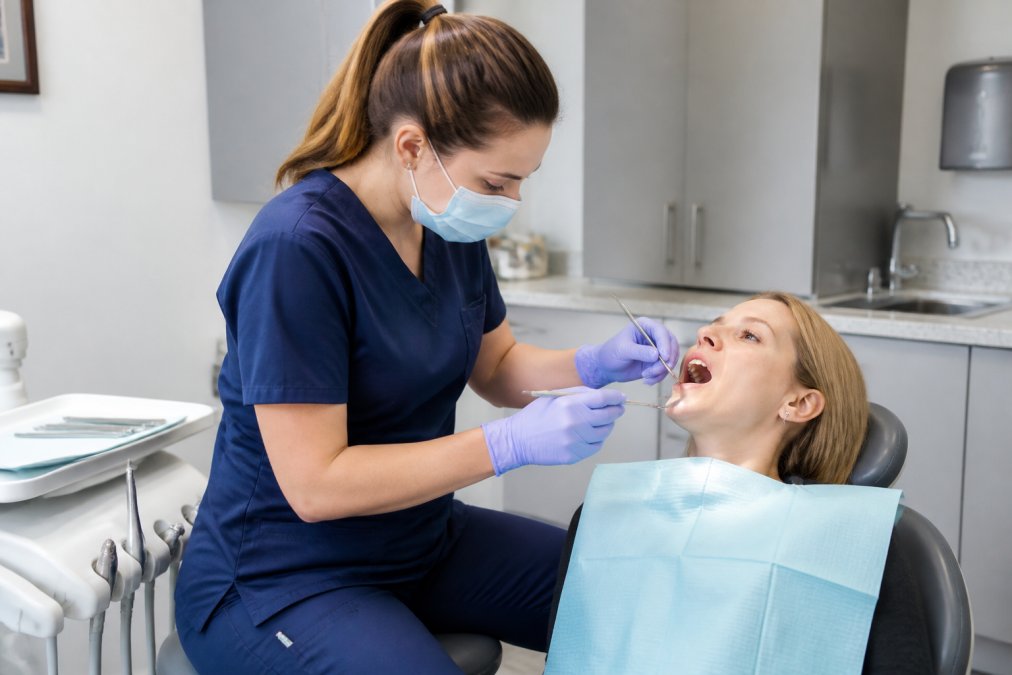
The Occupational Safety and Health Administration (OSHA) establishes standards for personal protective equipment in dental offices that directly shape scrub fabric and construction requirements. While OSHA doesn't mandate specific scrub styles, it requires that workwear support infection control protocols and protect workers from bloodborne pathogen exposure under the Bloodborne Pathogens Standard (29 CFR 1910.1030).
Fabric Requirements for Infection Control Compliance
OSHA requires that workwear be cleanable and replaceable, meaning scrubs must withstand high-temperature, chemical-intensive industrial laundering processes that eliminate pathogens. Dental scrubs must resist fluid penetration to prevent bloodborne pathogen transmission through fabric layers. Fluid-resistant fabrics with tightly-woven construction or applied coatings slow migration of blood and saliva through the garment, giving dental professionals time to change before contamination reaches skin.
Fabric weight and fiber composition directly impact fluid resistance. Scrubs woven from 5.5-6 ounce per square yard polyester-cotton blends provide better fluid resistance than lighter 4-ounce fabrics. Synthetic-dominant blends (65-75% polyester) with antimicrobial finishes applied during manufacturing maintain fluid resistance through multiple industrial wash cycles, whereas post-production treatments degrade quickly under bleach and alkaline detergents.
Seam and Construction Standards
OSHA compliance requires that scrubs maintain structural integrity through repeated industrial laundering without creating gaps where pathogens can penetrate. Reinforced seams, particularly at stress points like pocket corners, armholes, and crotch areas, prevent small tears that develop after 30-50 wash cycles. Double-stitched seams with thread count of 16-20 stitches per inch withstand mechanical agitation without unraveling. Serged seams prevent fraying that exposes inner fabric layers to fluid penetration. Gusseted crotches and underarm panels distribute stress across wider fabric areas, preventing concentrated wear that causes seam separation.
Laundry Protocol Compatibility
Dental offices typically launder scrubs at temperatures of 160-180°F with alkaline detergents and bleach to eliminate pathogens. Scrubs must withstand this without shrinking, fading, or losing elasticity. OSHA expects workwear remains functional and professional-looking throughout its service life of 80-100 wash cycles in dental settings.
Color-fastness becomes a compliance issue because faded scrubs can appear contaminated or unprofessional. Quality dyes bonded during manufacturing resist bleach and alkaline conditions, maintaining color integrity that supports visual infection control protocols. According to OSHA bloodborne pathogen standards, employers must provide appropriate workwear at no cost to employees and ensure it's laundered using infection control protocols. Scrubs that don't withstand these protocols create compliance gaps and expose practices to regulatory risk during OSHA inspections.
Professional Appearance and Staff Morale
The uniforms dental staff wear communicate professionalism to patients and influence how team members perceive themselves. Patients make judgments about clinical competence partly based on appearance. Staff wearing scrubs that fit well, maintain color, and look intentionally chosen project confidence and competence.
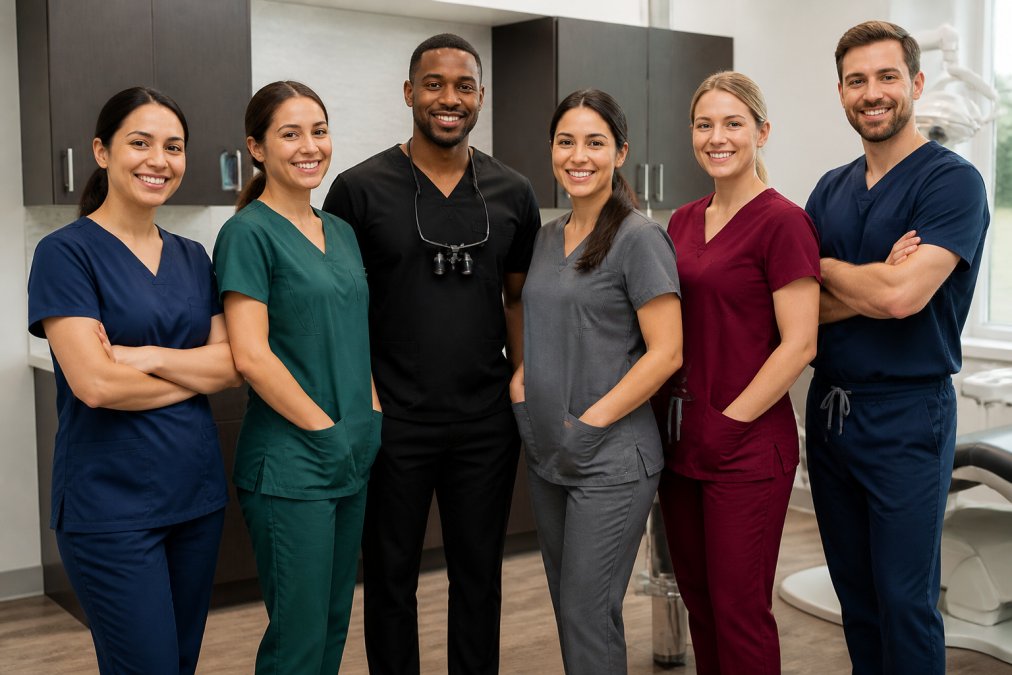
Scrub appearance affects internal team dynamics. When everyone wears quality, color-coordinated scrubs, it creates visual unity that influences team cohesion and how patients perceive the practice as organized and professional. Staff morale improves when workwear feels like a choice rather than a burden. Scrubs that fit well, feel comfortable, and look good make dental professionals feel better about their appearance during long shifts, translating to better patient interactions and team satisfaction.
Color selection matters more than many practices realize. Navy, charcoal, and black project authority and professionalism. Jewel tones like teal and burgundy feel modern while remaining professional. Many practices implement color coding where different roles wear different colors, dentists in navy, hygienists in teal, assistants in charcoal, helping patients quickly identify staff roles and creating visual organization that reinforces professional standards.
Budget vs. Investment: Finding Value Without Compromise
The scrub market includes options ranging from budget basics at under $15 per top to premium brands at $50+. The lowest-cost options often fail after 20-30 wash cycles. The real cost of scrubs isn't the purchase price, it's total cost of ownership including replacement frequency and the disruption of uniform inconsistency. A $20 scrub lasting 80 wash cycles costs less per wear than a $15 scrub failing after 30 cycles.
Professional scrubs from love2wear_scrubs balance durability with accessible pricing, engineered to withstand industrial laundering while keeping costs lower than premium brands charging for designer aesthetics rather than functional superiority.
Calculate actual scrub needs: multiply staff count by the number of scrubs each person needs (typically 5-7 per person for offices with weekly laundering). A practice with five staff members needing seven scrubs each requires 35 total scrubs. Investing in scrubs lasting 80+ cycles versus 30 cycles reduces total cost significantly over three years. Many manufacturers offer volume pricing that reduces per-unit costs for practices buying multiple sizes and colors. Buying a year's worth of scrubs upfront typically saves 15-25% versus purchasing smaller quantities throughout the year.
Quality doesn't require premium pricing. Scrubs engineered specifically for dental work with professional-grade fabrics and construction deliver durability and functionality without designer markup.
Choosing professional scrubs for dental office staff requires balancing durability, functionality, and budget. The scrubs your team wears influence patient perception, staff morale, and your actual cost of maintaining uniforms. love2wear_scrubs delivers professional medical apparel engineered for dental environments with durable fabrics, ergonomic design, and modern fit that supports all-day comfort through long shifts. Explore our full range of professional scrubs designed specifically for dental hygienists, assistants, and dentists at love2wear_scrubs and find the right fit for your practice.
Frequently Asked Questions
What features should dental staff look for in professional scrubs?
Dental professionals should prioritize moisture-wicking fabric, four-way stretch for mobility during chairside work, antimicrobial treatments for infection control, and functional pockets deep enough to secure instruments without tearing. Durability matters too, look for fabrics approved for industrial laundering, which indicates they'll maintain shape and color through frequent washing. A tailored fit that doesn't ride up or shift during 12-hour shifts separates quality scrubs from basic options.
Are there specific fabric requirements for dental office uniforms?
While OSHA doesn't mandate specific fabrics, dental offices should choose materials that support infection control and clinical safety. Antimicrobial and fluid-resistant treatments are essential for preventing cross-contamination. Four-way stretch and breathability reduce fatigue during long shifts. Poly-cotton blends and performance fabrics with moisture-wicking properties offer durability and comfort. Avoid fabrics prone to pilling or fading, as they undermine professional appearance and may indicate poor quality that won't survive frequent industrial laundering.
How do dental scrubs differ from surgical scrubs?
Dental scrubs prioritize comfort and mobility for chairside work, with features like four-way stretch, moisture-wicking, and functional pockets for hand tools and instruments. Surgical scrubs emphasize fluid resistance and sterility for operating rooms, often with more restrictive fits and fewer pockets. Dental scrubs typically allow more color variety and modern styling, while surgical scrubs follow stricter standards. Both should meet infection control standards, but dental scrubs are designed for the specific physical demands of hygiene and assistant roles.
What color scrubs do dental offices typically require?
Color choices vary by practice. Many dental offices use color-coding to identify staff roles: hygienists in one color, assistants in another, and administrative staff in a third. This visual system improves patient communication and staff organization. Some practices allow solid colors like navy, teal, or ceil blue, while others permit multiple colors. Check with your employer for specific requirements. Regardless of color, ensure the fabric resists color fading through industrial laundering to maintain a professional appearance over time.
This article was written using GrandRanker