

Scrubs and Beyond vs Competitors: 2026 Comparison Guide
Table of Contents
- Scrubs and Beyond vs Competitors: Quick Comparison Table
- Fabric Quality and Durability: What Actually Lasts
- Affordable Scrubs for New Nurses: Price Point Analysis
- Sizing, Fit Guides, and Size Inclusivity
- Retail Footprint vs Online Shopping Experience
- Group Ordering and Institutional Discounts
- Long-Term Durability: What to Expect After 50 Washes
- Frequently Asked Questions
Last Updated: September 14, 2026
Scrubs and Beyond vs Competitors: Quick Comparison Table
With national retail chains closing locations and healthcare systems consolidating uniform procurement, nurses and clinical staff now buy scrubs largely through direct-to-consumer e-commerce. At love2wear_scrubs, we track these shifts because they define how healthcare apparel reaches the people wearing it for twelve hours at a time.
Here is how the options stack up.
| Option | Price Range | Fabric Focus | Sizing | Best For |
|---|---|---|---|---|
| love2wear_scrubs Scrub Sets | $32.57-$50.40 | Polyester, cotton blend, four-way stretch | S-XXXL | Value-focused nurses, students, clinical teams |
| Legacy retail chains | Mid-to-premium | Branded technical fabrics | S-3XL | Try-before-you-buy shoppers |
| Big-box workwear brands | Budget | Cotton-poly basics | S-2XL | Occasional use |
| Specialty uniform retailers | Premium | Proprietary blends | S-5XL | Institutional buyers |
The rest comes down to fabric, fit, and how each option holds up after months of washing.
Fabric Quality and Durability: What Actually Lasts
Fabric quality is the biggest predictor of whether scrubs survive a year of clinical work. Most complaints about fading, shrinking, and pilling trace back to fabric composition, yarn construction, and finishing, not the brand name. Two sets can carry the same "poly-cotton blend" tag and perform completely differently after 30 washes.
The variables that actually matter:
- Fiber ratio. A 65/35 polyester-cotton blend behaves very differently from a 95/5 performance blend. Higher polyester content resists shrinkage and color loss; higher cotton content feels softer but pills faster at friction points.
- Fabric weight. Clinical scrubs typically run 4.5 to 7.5 oz per square yard. Lighter fabric breathes better in warm units but wears through faster at the seat and knees. Heavier fabric holds shape but can feel stiff on a 12-hour shift.
- Knit vs. woven construction. Most scrub tops are knit (jersey or ponte), which gives natural stretch and drape. Woven poplin is more common in budget workwear and resists wrinkles but has almost no give.
- Finishing treatments. Moisture-wicking, antimicrobial, and soil-release finishes are applied after the fabric is knit. These finishes degrade with heat and fabric softener, which is why the same set can feel different after six months of hot-water washing.
Polyester-dominant blends hold color and shape better than pure cotton over repeated industrial washing. Cotton blends feel softer initially but break down faster at stress points like the shoulders and seat. The difference shows around wash 30, when cheap fabric pills and premium fabric still looks new.
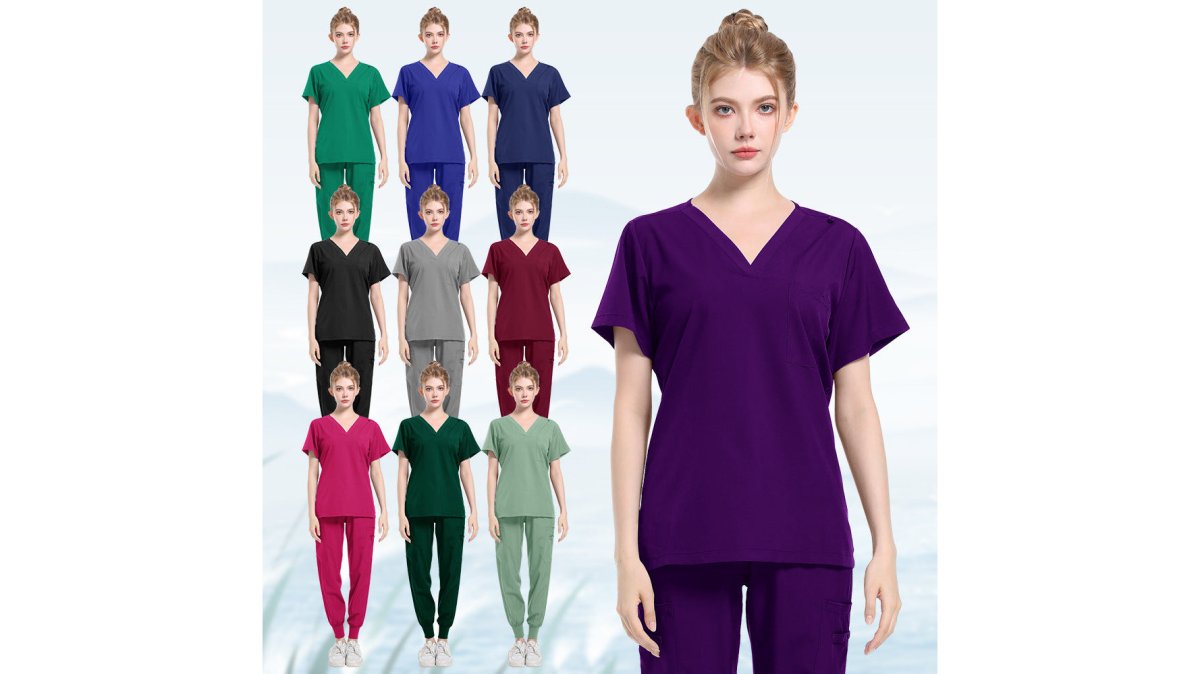
Four-Way Stretch and Moisture-Wicking Explained
Four-way stretch means the fabric flexes crosswise and lengthwise, so it moves with you when you bend, reach, or crouch. Two-way stretch only gives in one direction, which is why some scrubs feel fine standing still and restrictive the moment you lift a patient. Moisture-wicking pulls sweat to the fabric surface, where it evaporates faster. Together they determine how a scrub feels at hour ten of a twelve-hour shift.

The OSHA guidance on healthcare worker safety and ergonomics underscores why mobility matters in clinical settings: restricted movement contributes to strain injuries over time. Stretch fabric reduces that friction.
What Actually Fails First (and Why)
- Pilling at the inner thigh and underarm, friction between fabric and skin breaks surface fibers. Shows up around wash 20-40 on low-quality blends.
- Color fade at the shoulders and back, UV exposure and repeated washing strip dye from the most-exposed panels first.
- Seam separation at the crotch and pocket corners, stress points where cheap thread and single-stitched seams give out before the fabric does.
- Elastic failure at the waistband, heat from the dryer breaks down spandex, causing waistbands to lose snap and drawstrings to lose grip.
Cold-water washing and air drying can add a full year of usable life.
Affordable Scrubs for New Nurses: Price Point Analysis
Affordable scrubs for new nurses typically land between $30 and $55 per set, and that is where most nursing students and new grads should shop (Registered Nurses : Occupational Outlook Handbook: : U.S. Bureau of Labor Statistics). No one needs to spend $90 on a single set to look professional.
New nurses work back-to-back shifts and need enough uniforms to get through a wash cycle without scrambling.
The love2wear_scrubs Solid-color V-neck Scrub Set at $32.57 is built for exactly this buyer: a new grad who needs professional attire without the premium markup. The Scrub Sets option at $44.40 adds moisture-wicking fabric suited to all-season wear.

Sizing, Fit Guides, and Size Inclusivity
Sizing is where most online scrub purchases go wrong, and most ranking articles stop at "check the size chart." That advice is useless if you do not know what to measure, how brands cut their patterns, or where the size range ends.
The Measurements That Matter
For scrub tops, the three numbers that determine fit are:
- Bust/chest, measured at the fullest point, tape parallel to the floor.
- Waist, measured at the natural waist, not at the top of the hip.
- Length from shoulder to hem, the number most shoppers ignore, and the one that decides whether a top stays tucked or rides up when you reach overhead.
For scrub pants, add inseam and rise. A pant that fits at the waist but has a 29-inch inseam will not work for someone who needs a 33-inch inseam, no matter what the size letter says.
Why the Same Letter Size Fits Differently Across Brands
A medium is not a medium. Brands cut patterns to different blocks:
- Asian sizing runs one to two sizes smaller than American sizing, so a medium from an overseas manufacturer often fits like a small. This is the single most common source of returns in medical apparel.
- Athletic or slim cuts run narrower through the chest and hip, which works for some body types and not others.
- Unisex cuts are drafted to a men's block, which means women often need to size down one letter for a comparable fit.
- Petite and tall lines adjust inseam and torso length, not overall size, a petite medium is not the same as a regular small.
A nurse who wears a medium in one brand may need a large in another and a small in a third, a pattern-drafting difference, not a sizing failure on the shopper's part.
Where Size Ranges Actually End
Here is the honest landscape:
- Big-box workwear brands typically stop at 2XL, sometimes 3XL, and rarely offer petite or tall.
- Legacy retail chains often carry S-3XL in stores but limit extended sizes to online-only, with fewer color options.
- Specialty uniform retailers reach S-5XL but at premium pricing.
- love2wear_scrubs carries S through XXXL across the Four-Way-Stretch Scrub Set, with most other sets running S to XXL. The size range covers the majority of clinical staff, though shoppers at the far ends of the spectrum should confirm measurements against the chart rather than assuming a standard fit.
If you fall outside a brand's range: order from a supplier that stocks your size, have a tailor take in a larger set at the waist and hem ($15-$30 per set), or mix sizes, a larger top with a smaller pant, which many nurses do anyway.
Fit Consistency: What to Expect Across a Rotation
If you are building a rotation of three or more sets, order them at once from the same colorway and wash the first set before committing to the rest.
For anyone unsure, customer service can help match measurements to the right size. That single step prevents the most common return reason in medical apparel.
Retail Footprint vs Online Shopping Experience
Online shopping offers broader color ranges, more sizes, and better pricing, though you cannot try before buying.
The trade-off is straightforward: physical stores let you feel the fabric and check fit immediately, while online stores offer the full catalog, lower prices, and delivery.
FTC guidance on online shopping rights and returns explains the consumer protections that apply to distance purchases, which matters when a size does not work out.
Group Ordering and Institutional Discounts
Group ordering changes the math for clinics, nursing schools, and hospital units. Bulk procurement through a direct supplier beats per-unit retail pricing and keeps an entire team in matching, compliant uniforms.
The practical approach: designate one person to collect sizes and colors from the team, place a single order, and distribute on arrival. This avoids the mismatched-color problem that plagues departments where everyone buys independently.
Uniform compliance also gets easier when a whole unit orders from the same supplier, since dress codes specifying color and style are simpler to meet from one catalog.
Long-Term Durability: What to Expect After 50 Washes
Polyester blends hold color, resist pilling, and maintain shape.
Wash them inside out in cold water and skip the dryer when you can. Line drying adds years to garment longevity and costs nothing.
The love2wear_scrubs New Stretch Quick-drying Medical Scrubs at $46.10 and the Four-Way-Stretch Scrub Set at $50.40 are both built for repeated industrial washing, which is the standard in most hospital laundry systems.

Frequently Asked Questions
Is Scrubs and Beyond reputable for online orders?
Compare fabric weight, stretch, and return terms before ordering, and check whether you can try a single set before committing to a bulk purchase.
What are the best affordable scrubs for new nurses?
New nurses typically need two to three sets to get through a week of 12-hour shifts without daily laundry. Look for moisture-wicking polyester blends with four-way stretch, which hold color and shape longer than basic cotton blends.
How do I choose the right scrub fabric for long shifts?
Prioritize moisture-wicking and stretch over softness alone. Polyester and polyester-blend fabrics dry faster and resist fading, while four-way stretch lets you bend, reach, and lift without the fabric pulling at the shoulders. Cotton blends feel breathable in summer but wrinkle more and can shrink after repeated hot washes. If you work in a warm clinic or ER, quick-drying polyester is the safer pick.
Are there better options for bulk scrub purchases for healthcare teams?
Group ordering usually means buying the same style in multiple sizes, so consistency matters more than brand name. Confirm the size range covers your whole team, check whether colors stay in stock, and ask about volume pricing before placing a large order.
What features should I look for when comparing scrub retailers?
Focus on five things: fabric composition, stretch type, pocket depth, size range, and return policy. Deep pockets that hold a phone, scissors, and stethoscope without tearing are a daily-use feature, not a bonus. Check whether the retailer offers sizes beyond XXL, and read the return window carefully, since fit problems are the most common reason healthcare workers switch brands.