

Scrubs with Secure Deep Pockets: 3 Options That Work
Table of Contents
- What Makes Pockets Secure and Deep Enough for a Full Shift
- Quick Comparison: Three Pocket Solutions for Healthcare Workers
- Pocket v-Neck Short-Sleeved Scrub Shirt: The Everyday Deep-Pocket Top
- Equipment Waist Pouch: When Your Scrubs Need Extra Carry Capacity
- Nurse Tool Storage Waist Bag: Organized Storage for Heavy Pocket Loads
- How to Measure for Scrub Fit Before You Buy
- Best Scrubs for Nurses with Pockets: Choosing the Right Setup
- Conclusion
- Frequently Asked Questions
Last Updated: September 12, 2026
What Makes Pockets Secure and Deep Enough for a Full Shift
Scrubs with secure deep pockets are medical uniforms built with reinforced, generously sized pocket compartments that hold a phone, scissors, penlight, and stethoscope without sagging, tearing, or spilling contents during movement. At love2wear_scrubs, we hear the same complaint from nurses constantly: pockets that look roomy online but fail by week three. Depth alone is not the answer. A pocket stays usable when the fabric resists stretch, the stitching at the stress points holds, and the opening is cut wide enough for a gloved hand.
Here is the throughline for this guide: pocket capacity is a fit problem as much as a fabric problem. A deep pocket on a top that rides up is still a useless pocket.
Three features separate a pocket that lasts a year from one that lasts a month:
- Bar-tacked stress points at the pocket mouth, where most tears begin
- Fabric weight and recovery so the pocket does not stretch out of shape
- Opening width sized for a phone or a folded stethoscope, not just a pen
The Occupational Safety and Health Administration guidance on personal protective equipment treats workwear as equipment that must suit the task, and pocket failure on a busy floor is exactly that kind of practical failure.
Quick Comparison: Three Pocket Solutions for Healthcare Workers
| Option | Price | Carry Capacity | Best For |
|---|---|---|---|
| Pocket v-Neck Short-Sleeved Scrub Shirt | $21.00 | Chest pocket for phone, penlight, scissors | Everyday shifts, light carry |
| Equipment Waist Pouch | $42.74 | 15 kg load rating, double-strand Oxford cloth | Extra carry capacity on top of scrubs |
| Nurse Tool Storage Waist Bag | $37.98 | Zipper bag, phone bag, file bag compartments | Organized storage for heavy loads |
The table makes the trade-off obvious. If your scrubs with secure deep pockets already hold what you need, the top is enough. If you carry more than a shirt pocket can take, a waist pouch solves it without buying a second uniform.

Pocket v-Neck Short-Sleeved Scrub Shirt: The Everyday Deep-Pocket Top
This is the pick for most nurses. At $21.00, the Pocket v-Neck Short-Sleeved Scrub Shirt is a polyester top with a modern fit, built for long shifts and easy care. The chest pocket takes a phone, a penlight, and a small pair of scissors without pulling the neckline sideways.
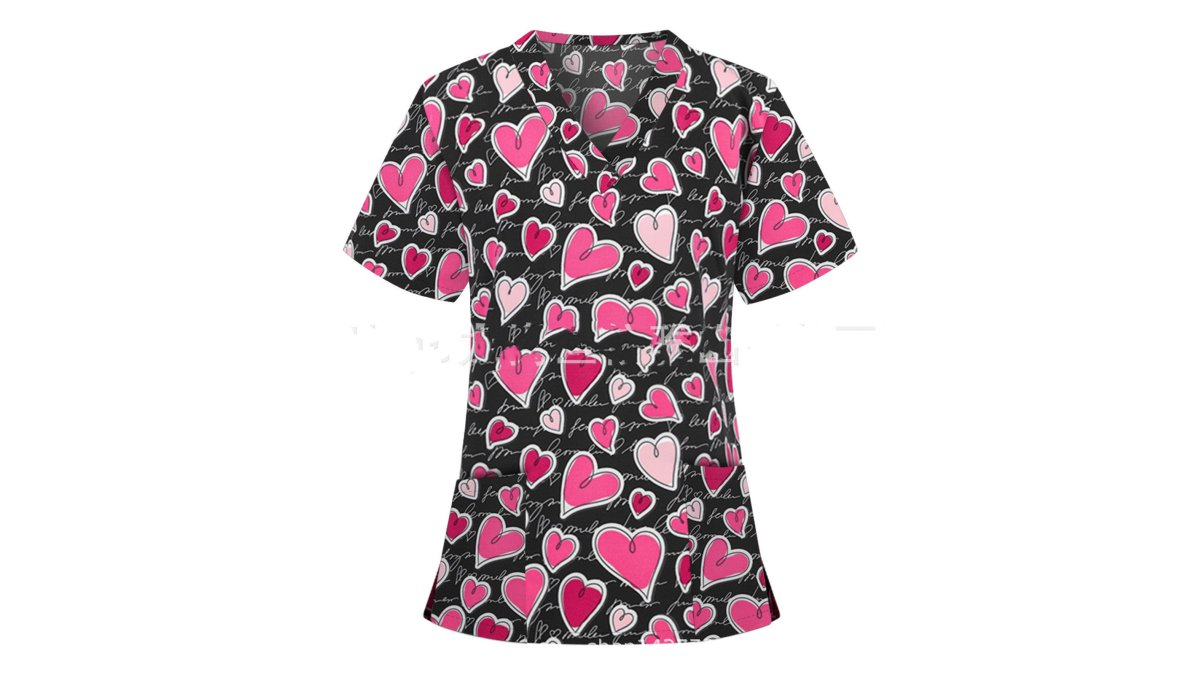
What most guides miss is that a chest pocket fails at the mouth, not the base. The fabric at the opening takes the entire load every time you reach in. Polyester holds its shape better than cotton here, which is why the 91-99% polyester blend matters more than the pocket depth number on a spec sheet (PubMed).
The honest limitation: this is a top, not a mobile storage system. If you routinely carry wound care supplies, a full med pass, or a tablet, no chest pocket will hold it comfortably. That is what the next two options are for.
Equipment Waist Pouch: When Your Scrubs Need Extra Carry Capacity
Buy the Equipment Waist Pouch ($42.74) when your scrubs with secure deep pockets run out of room mid-shift. It is a waist bag in double-strand Oxford cloth with a 15 kg load rating, sized 18 x 3 x 25 cm and weighing 300 g. Colors include black, purple, navy blue, and silver gray.

The load rating is the number that matters. Most waist packs are not rated at all, so you find the limit by overloading one and watching the strap give out. A rated pouch tells you the ceiling before you hit it.
Where it falls short: Oxford cloth is stiff compared to a knit scrub pocket, so it does not move with your body the same way. On a top that already fits close, adding a waist pouch changes your silhouette. Try it over the scrub top first before committing to a full shift.
Nurse Tool Storage Waist Bag: Organized Storage for Heavy Pocket Loads
Organization is the reason to choose the Nurse Tool Storage Waist Bag ($37.98) over a plain pouch. Its internal structure separates a zipper bag, a phone bag, and a file bag, so your scissors are not fighting your phone for the same space. Polyester construction, medium hardness, 23 x 15.5 cm, in dark blue, black, gray, army green, rose red, or purple.

The file bag is the underrated compartment. Nurses who carry printed shift notes, a small reference card, or a folded assignment sheet finally have somewhere flat to put them instead of cramming paper into a chest pocket where it crumples.
A common mistake is treating a waist bag as a replacement for pocket capacity. It is not. It is a supplement. The best setup pairs a deep-pocket top with a waist bag for the overflow, so the items you reach for constantly stay on your chest and the bulk stays at your waist.
How to Measure for Scrub Fit Before You Buy
Knowing how to measure for scrub fit prevents the most expensive pocket mistake: a top that fits everywhere except the shoulders, where a tight armhole drags the chest pocket out of reach every time you raise your arm.
Measure these four points with a soft tape, wearing the underlayer you normally wear on shift:
- Chest at the fullest point, tape level under the arms
- Natural waist at the narrowest point of your torso
- Hip at the fullest point, feet together
- Torso length from the shoulder seam to where you want the hem to sit
Compare each measurement to the size chart, then size up if any single measurement falls between two sizes. A scrub top that is slightly loose still functions. A scrub top that is slightly tight does not, because the pocket pulls away from your body every time you bend.
Measure the torso length before anything else. Pocket placement is fixed to the garment, so a top that sits two inches too high puts the pocket above your natural reach for the entire shift.
The Centers for Disease Control and Prevention guidance on healthcare worker safety is a useful reminder that workwear choices affect how safely and efficiently you move through a shift, not just how you look.
Best Scrubs for Nurses with Pockets: Choosing the Right Setup
The right setup depends on what you carry, not on which option costs the most. Match the load to the gear:
- Light carry (phone, penlight, scissors): the Pocket v-Neck top alone
- Medium carry (adds tape, alcohol swabs, a small notebook): the top plus the Nurse Tool Storage Waist Bag
- Heavy carry (adds wound care supplies, a tablet, bulk items): the top plus the Equipment Waist Pouch
Fabric choice follows the same logic. Polyester resists fading and shrinking better than cotton across repeated industrial washing, which matters when your scrubs go through a commercial laundry cycle several times a week. Breathability keeps the fabric from trapping heat during a twelve-hour shift, and the modern fit keeps the pocket against your body instead of swinging free.
If you are coming from a stiffer, heavier uniform, expect the first week to feel different. Lighter fabric moves more, and the pocket sits differently on your frame.
Conclusion
The hard part is not finding a deep pocket. It is finding a pocket that stays deep, stays attached, and stays within reach after a hundred washes and a thousand bends. Most scrubs fail that test somewhere around the third month.
love2wear_scrubs builds for that timeline: durable healthcare uniforms with a modern fit, breathable fabric, and easy care, at a price that does not punish you for replacing a worn set. Start with the Pocket v-Neck Short-Sleeved Scrub Shirt at $21.00, then add the Equipment Waist Pouch at $42.74 or the Nurse Tool Storage Waist Bag at $37.98 if your shift carries more than a chest pocket can hold.
Get started with love2wear_scrubs and build a pocket setup that survives the shift, not just the fitting room.
Frequently Asked Questions
How do I figure out my scrub size?
Measure your chest at the fullest point, your waist at the natural bend, and your hips at the widest part. Compare those numbers to the brand's size chart rather than assuming you are the same size in every brand. For tops, check shoulder width too, since tight shoulders restrict reaching. For bottoms, measure your inseam from crotch to ankle. If you are between sizes, size up for movement during bending and lifting.
Are deep pockets standard in modern scrub designs?
Not always. Many scrub tops have shallow chest pockets that barely hold a penlight, let alone a phone. Deep pockets that actually secure items usually appear on specific designs, like the Pocket v-Neck Short-Sleeved Scrub Shirt, or come as separate carry options such as a waist pouch. Check the pocket depth measurement and closure type before buying, especially if you carry a stethoscope or multiple tools.
What features should I look for in scrubs with secure deep pockets?
Look for reinforced stitching at pocket corners, a closure like a zipper or flap to stop items falling out when you bend, and fabric with enough weight that it does not sag under load. Polyester blends hold their shape through repeated washing better than thin cotton. Also check whether pockets sit where your hands naturally fall, since a deep pocket in the wrong spot is still awkward to use.
How should scrub bottoms fit if I carry items in my pockets?
Bottoms should sit at your natural waist without digging in, with enough room through the thigh to squat and kneel. If you load cargo pockets with scissors or tape, a drawstring or elastic waist keeps them from sliding down. Hem length matters too: aim for a slight break at the shoe so the fabric does not drag. Try the squat test in the fitting room before committing.
Do scrub sizes run big or small?
It varies by brand and cut. Modern-fit scrubs tend to run closer to streetwear sizing, while traditional unisex cuts run large and boxy. Always check the specific size chart for the item you are buying. If you plan to layer a long-sleeve shirt underneath or carry heavy pocket loads that pull at the fabric, sizing up gives you room to move without straining the seams.