

5 Best Durable Scrubs for Doctors 2026: Long-Lasting Picks
Table of Contents
- Quick Comparison: 5 Best Durable Scrubs for Doctors 2026
- How We Evaluated These Durable Scrubs
- 1. New Stretch Quick-drying Medical Scrubs: Best Overall for Long Shifts
- 2. Four-Way-Stretch Scrub Set: Best for Range of Motion
- 3. Mens Quick-Drying Comfortable Stretchy Scrubs Set: Best Value Pick
- 4. Moisture Wicking Scrub Set: Best for Breathability and Color Retention
- 5. Scrub Set Short Sleeve Quick Drying: Best Fabric Blend for Durability
- Best Fabric Blends for Durable Scrubs: What Actually Holds Up
- Frequently Asked Questions
Last Updated: September 13, 2026
Quick Comparison: 5 Best Durable Scrubs for Doctors 2026
Finding durable scrubs for doctors in 2026 comes down to fabric engineering, not brand hype. This guide was built around the metrics that actually predict how a scrub set performs after fifty industrial wash cycles: fabric blend, GSM weight, stretch recovery, and colorfastness. The five picks below are the ones that hold their shape, resist fading, and stay comfortable through a twelve-hour shift.
ASTM International textile testing standards matter here because "durable" is a measurable property, not a marketing claim.
| Scrub Set | Price | Fabric | Best For |
|---|---|---|---|
| New Stretch Quick-drying Medical Scrubs | $46.10 | Polyester, moisture-wicking | Best overall for long shifts |
| Four-Way-Stretch Scrub Set | $50.40 | Four-way stretch polyester | Best range of motion |
| Mens Quick-Drying Comfortable Stretchy Scrubs Set | $34.99 | Polyester, sweat-stain resistant | Best value pick |
| Moisture Wicking Scrub Set | $37.65 | Polyester, moisture wicking | Best breathability and color retention |
| Scrub Set Short Sleeve Quick Drying | $41.47 | 95% polyester + 5% spandex | Best fabric blend for durability |
How We Evaluated These Durable Scrubs
Most scrub roundups rank on comfort and price. Durability is treated as a vibe. Each set was scored on measurable properties instead, using the same categories textile labs use when they test medical apparel.

1. Fabric composition and weight. The fiber percentages and, where the manufacturer published it, the GSM were recorded. Polyester-dominant blends (roughly 90%+ polyester) scored highest for shrinkage resistance and colorfastness; cotton-heavy blends scored lower because cotton fibers pill and fade faster under repeated laundering. Weight was scored against intended use, not in absolute terms, a lightweight fabric is not "worse," it is just suited to a different environment.
2. Stretch recovery. This is the property that separates scrubs that still fit in month twelve from scrubs that sag by month three. The fabric's return to its original dimensions after repeated bending and stretching was assessed, which is a function of elastane content and quality. Four-way stretch (flexes both horizontally and vertically) scored above two-way stretch, because two-way fabric tends to ride up when you reach overhead.
3. Abrasion and pilling resistance. High-friction zones, inner thigh, underarm, seat, and the area where a stethoscope or badge rubs, are where cheap scrubs fail first. Reinforced stitching at stress seams, flatlock or double-needle construction, and bar-tacked pocket corners were considered. These are the construction details that determine whether a seam blows out at month six.
4. Antimicrobial and fluid-repellent finish durability. This is the category most guides skip entirely, and it is the one that matters most in clinical settings. Antimicrobial and fluid-repellent treatments are surface finishes, not permanent fiber properties. They degrade with every wash, and they degrade faster with heat, chlorine bleach, and fabric softener. A finish that performs well out of the box can be largely gone after fifty industrial wash cycles. Whether a manufacturer specified how the finish is applied (e.g., bonded vs. topical) and whether care instructions were designed to preserve it was assessed. Where a brand made a durability claim without specifying the finish type or wash protocol, the claim was discounted.
5. Colorfastness. Fading is the most visible durability failure. Dye systems described as colorfast or solution-dyed were considered, and the number of colorways each set offered was noted, a wider range usually signals a manufacturer with more control over its dye process.
6. Value. Price matters, but only against the other five criteria. A $50 set that survives two years of industrial laundering is cheaper per wear than a $30 set that fades and sags in six months. Price was scored relative to the durability profile, not in isolation.
ASTM International textile testing standards publishes the abrasion, pilling, and colorfastness test methods referenced above, which is why we cite test-method language rather than marketing terms.
1. New Stretch Quick-drying Medical Scrubs: Best Overall for Long Shifts
This set performs well on metrics important for a twelve-hour shift. The polyester construction is moisture-wicking and sweat-resistant, which keeps the fabric from clinging during rounds. Short sleeves and long pants suit all seasons, and the S through XXL range covers most body types. At $46.10, it offers quality features without a premium price tag.

What most guides miss is that quick-drying fabric also resists odor buildup, since bacteria need moisture to thrive. That single property extends wear time between washes and reduces the abrasive friction that breaks down fibers.
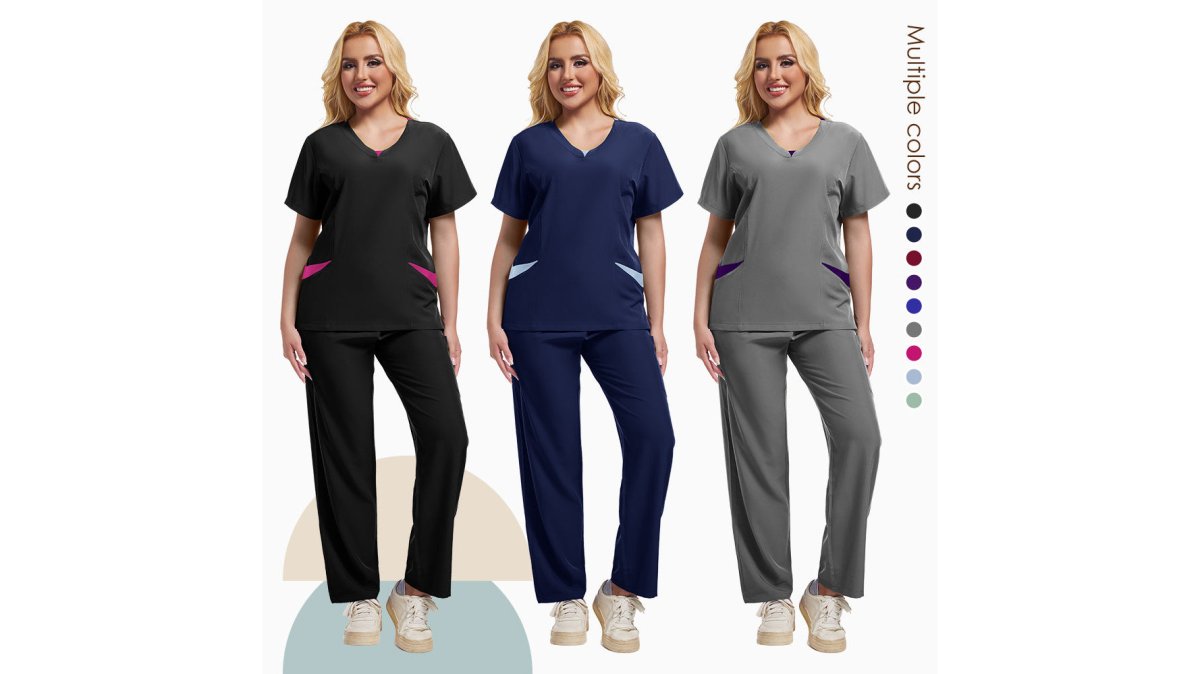
Pros: Moisture-wicking, all-season, wide size range Cons: Limited to five sizes; no extended tall option
2. Four-Way-Stretch Scrub Set: Best for Range of Motion
Range of motion separates functional scrubs from restrictive ones. The four-way stretch fabric here moves in every direction, which matters when you are reaching across a patient or crouching to check equipment. Polyester construction keeps it wrinkle-resistant, and the S through XXXL sizing is the widest in this lineup. At $50.40, it offers value for doctors who move constantly.
A common mistake is assuming all stretch fabric is equal. Two-way stretch only flexes horizontally; four-way stretch flexes vertically too, which prevents the ride-up problem many ER staff complain about.
3. Mens Quick-Drying Comfortable Stretchy Scrubs Set: Best Value Pick
Budget-conscious buyers should start here. At $34.99, this set delivers moisture-wicking, sweat-stain-resistant fabric across twelve color options, from navy blue to wine red. Full-length pants and short sleeves suit year-round wear, and the unisex cut works for both men and women. The tradeoff is sizing: it stops at XXL, so taller or larger frames may need to size up.
4. Moisture Wicking Scrub Set: Best for Breathability and Color Retention
Color retention is where some scrubs fail first, and this set offers good performance. The moisture-wicking polyester keeps fabric breathable during long shifts, while the ten-color range includes lake blue, sapphire, and dark green that resist fading. Sizes run S through XXL at $37.65. The set is lightweight and soft-touch, which helps in warm clinical environments where heavier fabric feels stifling.
5. Scrub Set Short Sleeve Quick Drying: Best Fabric Blend for Durability
The 95% polyester and 5% spandex blend offers a good balance for durability. Spandex adds stretch recovery; polyester adds colorfastness and shrinkage prevention. The result is a set designed to survive repeated washing without losing shape. Four colors, sizes S through 2XL, and a $41.47 price point make it a strong mid-range pick. The one drawback: fewer color options than the value pick.
Best Fabric Blends for Durable Scrubs: What Actually Holds Up
Durability in scrubs is a fiber-level property. Two sets can carry the same "polyester blend" label and behave completely differently after fifty industrial wash cycles, because what matters is the ratio, the weave, and the fabric weight, not the category name. Here is how the common blends actually compare in a clinical setting.
Polyester-spandex (typically 90-95% polyester / 5-10% spandex). This is the durability benchmark for most hospital and clinic roles. Polyester fibers are hydrophobic, which means they absorb almost no water, resist most aqueous stains, and hold dye in the fiber rather than on the surface, that is why colorfastness is high. Spandex (elastane) supplies the mechanical stretch and, critically, the recovery: after you crouch, reach, or bend, the elastane pulls the fabric back to its original dimensions. The failure mode to watch for is elastane fatigue. Over repeated hot-water washes and high-heat drying, the elastane filaments break down and the garment slowly loses snap, developing sag at the knees and elbows. Cold wash and low-heat drying directly slow that process.
Cotton-poly blends (typically 50-65% polyester / 35-50% cotton). These feel softer against the skin and breathe well in warm environments, which is why they remain common in outpatient and long-term care settings. The trade-off is structural: cotton fibers are hydrophilic, so they absorb moisture, take longer to dry, and are more prone to pilling and abrasion wear at high-friction points like the inner thigh and underarm. Cotton also holds dye less tenaciously than polyester, so fading shows up earlier. A cotton-poly blend can still be a good choice, it just needs a higher polyester percentage (60%+) to compete on longevity.
100% polyester. Maximum moisture-wicking, quick-drying, and colorfastness. The weakness is hand-feel and stretch: without spandex, the fabric has no mechanical give, so fit depends entirely on cut. It is a strong pick for roles with heavy fluid exposure where drying speed matters more than stretch.
Ripstop weaves. A ripstop pattern uses a grid of thicker reinforcement threads woven at intervals. If the fabric tears, the grid stops the rip from propagating. This is relevant for high-abrasion roles, ED, trauma, veterinary, and any setting with frequent equipment contact. Ripstop is a weave, not a fiber, so it can be applied to polyester or cotton-poly bases.
GSM (grams per square meter) is the weight metric to check. As a general guide: roughly 150-180 GSM reads as lightweight and breathable but wears faster at friction points; roughly 180-220 GSM is the mid-weight range most clinical scrubs target, balancing tear resistance against heat retention; above roughly 220 GSM the fabric feels substantial and resists rips well but traps heat during long shifts. There is no single correct number, match it to your environment.
What to look for on the label. A durability-forward spec sheet will list the fiber percentages, and increasingly the GSM. If a listing gives neither, treat the durability claim as unverified. ASTM International textile testing standards publishes the test methods (abrasion, pilling, colorfastness, dimensional stability) that manufacturers use to substantiate these claims, so a brand that references a specific test method is usually a brand that has actually run it.
For care, wash in cold water, skip fabric softener, and air-dry or tumble on low when possible. Those three habits slow elastane fatigue and dye loss more than any single fabric upgrade.
Frequently Asked Questions
Which brand of scrubs is the most durable?
Durability depends on fabric composition and construction more than brand name. Look for scrubs with a polyester-spandex blend, reinforced stitching at stress points, and a GSM weight between 180 and 220. The 5 best durable scrubs for doctors in 2026 all use moisture-wicking polyester blends that resist shrinking, fading, and pilling after repeated industrial laundering. Check for colorfastness ratings and stretch recovery if you wash your scrubs frequently.
Are moisture-wicking fabrics essential for durable doctor scrubs?
Yes. Moisture-wicking polyester pulls sweat away from your skin, which reduces fabric saturation and bacterial growth. Saturated cotton breaks down faster because moisture weakens fibers over time. Polyester blends dry quickly between shifts and hold their shape better after 50+ washes. For doctors working 12-hour shifts in high-stress environments, moisture-wicking fabric is not a luxury; it directly extends the life of your scrubs.
How do you choose scrubs that withstand frequent industrial laundering?
Check three things: fabric blend, stitching quality, and colorfastness. A polyester-spandex blend (95/5 or similar) handles high heat and detergent better than cotton. Reinforced stitching at shoulders, pockets, and seams prevents blowouts. Colorfastness matters because industrial washing strips dye faster than home washing. Look for scrubs labeled wrinkle-resistant and shrinkage-prevention treated. Wash in cold water and avoid fabric softener to extend lifespan further.
What features should doctors look for in high-quality medical apparel?
Prioritize four-way stretch for bending and reaching, deep utility pockets with reinforced bar tacks, and a tapered fit that stays in place without restricting movement. Antimicrobial finishes and fluid-repellent coatings add protection in clinical environments. Check that the scrub set includes a top and pants with consistent sizing. Also verify the fabric weight: 180-220 GSM offers the best balance of breathability and durability for long-shift comfort.
What are the trends for medical scrubs in 2026?
In 2026, durable scrubs focus on sustainable materials, gender-neutral sizing, and advanced fabric technology. Expect more recycled polyester blends, antimicrobial finishes tested against clinical pathogens, and fluid-repellent treatments that meet healthcare safety standards. Four-way stretch and ripstop fabric are becoming standard in premium scrubs. Size-inclusive options now range from XS to 3XL, and brands are publishing durability scores based on wash-cycle testing.
Doctors need scrubs that survive industrial laundering, long shifts, and constant movement without fading or losing shape. love2wear_scrubs builds medical apparel around exactly those demands, with moisture-wicking fabric, four-way stretch options, and a modern fit designed for all-day comfort at a price that does not punish you for buying quality. Explore the full collection and find the set that lasts.