

How to Prevent Scrubs from Shrinking: A 2026 Care Guide
Table of Contents
- Why Scrubs Shrink: Fabric Fibers and Heat
- Do Polyester Scrubs Shrink? What You Need to Know
- How to Wash Medical Scrubs Without Shrinking Them
- Drying Methods That Prevent Scrubs from Shrinking
- Wrinkle Free Scrubs for Nurses: Fabric and Care Tips
- How to Restore Scrubs That Already Shrunk
- Conclusion: Build a Laundry Routine That Protects Your Scrubs
- Frequently Asked Questions
Last Updated: September 11, 2026
Why Scrubs Shrink: Fabric Fibers and Heat
Shrinkage happens when heat and moisture make fabric fibers contract, and understanding that mechanism is the first step in how to prevent scrubs from shrinking. Cotton absorbs water and swells, then contracts as it dries under heat (peer-reviewed research). Synthetic blends behave differently, but they are not immune.
The two forces behind most shrinkage are fiber relaxation and fabric warping. Fiber relaxation occurs when yarns stretched during manufacturing snap back after the first few washes. Fabric warping happens when high heat distorts the weave itself, which is why a hot dryer often does more damage than a hot wash.
Scrubs face a tougher version of this problem than most clothing. They get washed constantly, and frequent washing accelerates whatever shrinkage the fabric is prone to. The fix is simple but requires consistency across every wash cycle.
Do Polyester Scrubs Shrink? What You Need to Know
Polyester scrubs shrink far less than cotton ones, but "less" is not the same as "never." Polyester is a thermoplastic, extruded as a filament, stretched while hot, and cooled into a shape it "remembers." That heat-set memory is why it holds its dimensions through repeated washing, and it does not swell with water the way cotton does.
The catch is heat. Every thermoplastic softens and loses its set shape at some point. For medical-workwear polyester, that point sits above normal wash temperatures but within reach of a hot dryer or commercial laundry press. Cross it, and the fiber relaxes into a smaller configuration, shrinkage, puckering, or a stiff hand feel, and the damage is not reversible, because the fiber itself has been re-set.
Spandex (also listed as elastane or Lycra) is the more fragile component, added at roughly 3-10% in most stretch scrub fabrics for recovery (peer-reviewed research). Repeated heat exposure breaks down its elastic bonds, so the fabric stops snapping back, sagging knees, stretched-out waistbands, looseness where it used to hug. That is why a set can look fine for six months and then suddenly feel "worn out" even though the fabric is intact.
Fabric-by-Fabric Shrinkage Guide
Not all "polyester scrubs" behave the same. The blend ratio drives everything:
| Fabric | Typical Shrinkage (first wash, cold/low) | Heat Tolerance | Care Priority |
|---|---|---|---|
| 100% cotton | 3-5% | Low | Cold wash, air dry |
| Cotton-poly blend (50/50 to 65/35) | 1-3% | Moderate | Cold wash, low dry |
| 100% polyester | Under 1% | High (but not unlimited) | Cold wash, low dry |
| Poly-spandex (95/5 or 92/8) | Under 1% if cared for; more if abused | Low for the spandex portion | Cold wash, air dry preferred |
| Rayon or modal blends | 4-8% | Low | Cold wash, lay flat to dry |
A 100% polyester set washed cold and dried low holds its shape for years. A cotton-poly blend shrinks between the extremes, with the cotton doing most of the contracting, gradually over the first several washes, not just the first. A poly-spandex set stays dimensionally stable until heat breaks down the spandex, at which point the fit degrades without technically "shrinking."
The practical takeaway: read the fiber content tag, not the marketing copy. "Wrinkle-resistant" and "easy-care" say nothing about shrinkage; the percentage breakdown does.
The Pre-Wash Myth
A common laundry claim: pre-washing new scrubs in hot water "pre-shrinks" them so they will not shrink later. This is half true and mostly misleading.
Pre-washing accelerates fiber relaxation that was going to happen anyway. If a cotton-rich scrub will shrink 4%, one hot wash before wearing gets most of it out of the way, but you have shrunk the garment before ever wearing it, which defeats the purpose if the fit was already correct. For polyester and poly-blends, pre-washing does essentially nothing.
The honest version: pre-washing does not prevent future shrinkage, it front-loads it. For cotton scrubs, wash cold and air dry from day one and accept slight relaxation over the first few washes. For zero shrinkage risk, buy polyester-dominant fabric and skip the pre-wash ritual entirely.
How to Wash Medical Scrubs Without Shrinking Them
Washing medical scrubs without shrinkage comes down to three variables: water temperature, detergent choice, and cycle setting. Control those, and you eliminate most of the risk before the dryer even enters the picture.

Start with these steps:
- Turn scrubs inside out to protect the outer surface and reduce friction
- Use a cold water wash on a gentle cycle
- Skip the fabric softener
- Wash with similar fabrics, not heavy towels or denim
- Remove promptly when the cycle ends
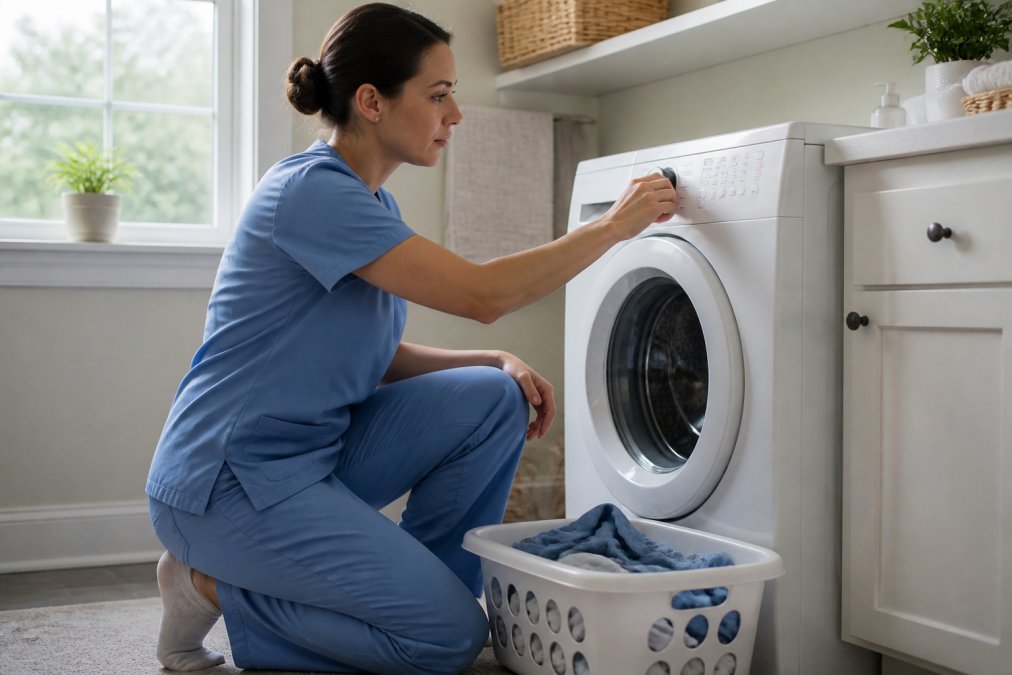
That last step matters: scrubs left damp in the drum develop deep wrinkles that tempt you to reach for high heat later.
Water Temperature: Cold Water Wash vs. Warm
Cold water is the single most effective shrinkage prevention tool you have. Heat drives fiber contraction, so keeping wash temperature low removes the primary cause. Warm water is acceptable for heavily soiled loads if the label allows it, but hot water should stay out of your scrub routine entirely.
If you are dealing with bodily fluids or contamination, check the care instructions first. Most modern scrubs tolerate warm water fine, but the trade-off is a slightly higher shrinkage risk over many washes, so reserve warm for when you genuinely need it.
Detergent and Fabric Softener: What Helps, What Hurts
Detergent choice affects shrinkage less than temperature, but it still shapes how your scrubs age. A gentle liquid detergent for synthetic blends cleans effectively without stressing fibers; powder detergents can leave residue that stiffens fabric over time.
Fabric softener is the bigger problem. It coats synthetic fibers with a waxy film that traps odors, reduces moisture wicking, and breaks down spandex elasticity. Skip it entirely; if static is an issue, a wool dryer ball works without the coating.
Drying Methods That Prevent Scrubs from Shrinking
Air drying is the safest method for any scrub fabric. Line drying or laying flat avoids heat exposure altogether and costs nothing; the trade-off is time, which matters when rotating three sets through a weekly routine.
If you use a dryer, choose tumble dry low. Remove scrubs while slightly damp and hang to finish, this cuts dryer time roughly in half while still softening the fabric. Avoid high heat completely, since it directly causes shrinkage and fabric warping.
| Drying Method | Shrinkage Risk | Best For | Time to Dry |
|---|---|---|---|
| Air dry / hang dry | Lowest | All fabrics, daily rotation | 4-8 hours |
| Tumble dry low | Low | Polyester and blends | 30-40 minutes |
| Tumble dry medium | Moderate | Rarely recommended | 25-35 minutes |
| Tumble dry high | Highest | Never for scrubs | 20-30 minutes |
A practical compromise many nurses use: tumble dry low for ten minutes to knock out wrinkles, then hang dry the rest of the way, a wrinkle-free finish without the heat damage.
Wrinkle Free Scrubs for Nurses: Fabric and Care Tips
Wrinkle-free scrubs for nurses start with the right fabric, not the right iron, and the reason is mechanical. Wrinkles form when cellulose fibers (cotton, rayon, modal) crease and hydrogen bonds between polymer chains lock the crease in place, set by heat and moisture during drying. Polyester lacks those bonding sites in the same density, so it springs back to shape instead of holding a fold. That is why 100% polyester comes out of the dryer looking pressed and 100% cotton looks like it slept in a drawer.
Most "wrinkle-free" and "easy-care" scrub fabrics are polyester-dominant blends, often 90-100% polyester with a little spandex for stretch. The wrinkle resistance is built into the fiber, so your care routine only needs to preserve it, not create it.
What Actually Breaks Wrinkle Resistance
Three things degrade the wrinkle-free property over time, and all three are avoidable:
- Fabric softener. Softener deposits a waxy cationic film on the fiber surface. On polyester, that film traps odor (a real problem in clinical settings) and interferes with the fiber's ability to shed water and spring back. Over months, buildup makes a wrinkle-resistant scrub crease like cotton. Skip it entirely.
- Overloading the washer or dryer. Cramming scrubs against heavy towels or denim presses creases into fabric while it is hot and pliable. Wash scrubs with similar lightweight items and dry with room to move.
- High heat. Heat above the low setting can re-set polyester into whatever shape it holds when it cools, including a wrinkled one. Tumble dry low, or remove while slightly damp and hang to finish.
Detergent Choice: What Helps and What Hurts
Detergent matters less than temperature, but it is not neutral:
- Liquid detergents dissolve fully in cold water and rinse clean, the safer default for synthetic blends.
- Powder detergents can leave undissolved residue in cold-water washes, especially in high-efficiency machines. That residue stiffens fabric and leaves a chalky film on dark scrubs.
- Detergents with optical brighteners or heavy fragrance do not damage fibers but can irritate sensitive skin, a real consideration for twelve-hour shifts.
- Enzyme detergents (protease, amylase) work on protein-based soils and are generally fine on polyester, but check the label if your scrubs contain spandex, since some formulations are harsher on elastane over time.
- Chlorine bleach should never touch scrubs. It weakens the fiber structure and dramatically shortens garment life. To sanitize, use the lowest-temperature wash your facility's protocol allows, then a proper dry cycle.
A Practical Rotation for Nurses
If you rotate three or four sets through a weekly laundry cycle, the routine that preserves fit and wrinkle resistance is simple:
- Turn scrubs inside out and zip or button any closures.
- Wash cold on a gentle cycle with a liquid detergent, no softener.
- Tumble dry low for 10 minutes to release wrinkles, then hang to finish.
- Hang immediately, do not let damp scrubs sit in the drum.
Quick-drying polyester sets shed water fast, shortening the window where wrinkles can set. For nurses building a rotation, the New Stretch Quick-drying Medical Scrubs combine moisture-wicking polyester with a stretch fit built for long shifts, priced at $46.10. The New Solid Color Scrub Sets run $34.13 and hold their shape well under cold-water care. Love2wear Scrubs designs both around easy-care fabric, so the laundry routine stays simple.

The real difference between scrubs that stay crisp and scrubs that wrinkle comes down to two habits: cold water and low heat. Everything else is secondary.
How to Restore Scrubs That Already Shrunk
Already-shrunk scrubs can sometimes be recovered, though results depend on how much heat damage occurred. The method works best on natural fibers and mild shrinkage; polyester warped by high heat is harder to bring back because the fiber structure itself has changed.
Try this restoration sequence:
- Soak the scrubs in cool water with a small amount of gentle detergent for 30 minutes
- Gently stretch the fabric by hand while it is still wet, focusing on cuffs, hems, and seams
- Lay flat to dry on a clean towel, reshaping as it dries
- Repeat the stretch-and-dry cycle once more if the first attempt only partially works
For stretch fabrics, this often recovers a noticeable amount of length and width. For 100% polyester that shrank from dryer heat, expect limited improvement, the set has likely reached the end of its useful fit.
Conclusion: Build a Laundry Routine That Protects Your Scrubs
The gap between scrubs that last a year and scrubs that fade and shrink in three months is not luck. It is a consistent laundry routine built on cold water, gentle detergent, and low-heat drying.
That routine protects more than fabric, it protects your workwear investment and the professional appearance you rely on every shift. Love2wear Scrubs builds durable, breathable scrubs with a modern fit and easy-care fabric, so care stays manageable even on a busy week. Browse the full range and find a set that holds its shape wash after wash.
Frequently Asked Questions
What is the best way to wash scrubs to prevent shrinking?
Wash scrubs in cold water on a gentle cycle with a mild detergent. Cold water prevents fabric fibers from relaxing and contracting, which is the main cause of shrinkage. Turn scrubs inside out to protect the outside finish, and avoid overloading the machine. For polyester blends, skip fabric softener because it can coat fibers and reduce moisture-wicking properties. Following these steps helps maintain garment longevity and fit.
Do cotton scrubs shrink more than polyester blends?
Yes. Cotton scrubs shrink more because natural cotton fibers swell and contract when exposed to heat and moisture. Polyester blends, especially those with spandex, resist shrinkage because synthetic fibers are heat-set during manufacturing. If you choose cotton-rich scrubs, expect some shrinkage on the first few washes. Polyester scrubs hold their size better over time.
Can I put my scrubs in the dryer without them shrinking?
You can, but use low heat or a tumble dry low setting. High heat is the main cause of shrinkage for both cotton and synthetic blends. Remove scrubs while they are still slightly damp and hang them to finish drying. If you want zero risk, air dry or hang dry your scrubs. This method also saves energy and extends the life of the fabric.
How do I restore scrubs that have already shrunk?
Soak shrunk scrubs in cold water for 15 to 30 minutes. Gently stretch the garment back to shape while damp, then lay it flat to air dry. Avoid wringing or twisting. This restoration technique works best on cotton or cotton-blend scrubs. Polyester scrubs that shrunk from high heat may not recover fully because synthetic fibers can permanently warp.
Shrinking scrubs is a solvable problem, but only if you treat laundry as part of garment maintenance rather than an afterthought. Love2wear Scrubs offers breathable, durable scrubs designed for long shifts, with easy-care polyester fabric that responds well to cold-water washing and low-heat drying. Get started with love2wear_scrubs and build a rotation that keeps every set fitting the way it did on day one.