

Comfortable Nursing Scrubs That Last: 2026 Top Picks
Table of Contents
- Quick Comparison: Comfortable Nursing Scrubs That Last
- How We Evaluated These Scrubs
- 1. New Stretch Quick-drying Medical Scrubs: Best Overall for Long Shifts
- 2. Stretchy, Quick-drying Scrubs: Best Value for Everyday Wear
- 3. Four-Way-Stretch Scrub Set: Best for Maximum Mobility
- 4. Moisture Wicking Scrub Set: Best for Hot Clinical Settings
- 5. Men's Quick-Drying Comfortable Stretchy Scrubs Set: Best Budget Pick
- 6. Men's V-neck Lightweight And Breathable Scrubs: Best for Breathability
- How to Care for Nursing Scrubs So They Last
- Best Scrub Fabric for Durability
- Sizing and Fit Considerations for Medical Professionals
- Frequently Asked Questions
Last Updated: September 11, 2026
Quick Comparison: Comfortable Nursing Scrubs That Last
Finding comfortable nursing scrubs that last comes down to fabric composition, stitching quality, and fit. This guide breaks down six options built for long shifts, evaluated on stretch, moisture management, and durability, with real pricing, honest trade-offs, and who each suits best.
| Scrub Set | Price | Fabric | Best For |
|---|---|---|---|
| New Stretch Quick-drying Medical Scrubs | $46.10 | Polyester, moisture-wicking | Long shifts |
| Stretchy, Quick-drying Scrubs | $43.89 | Polyester, quick-dry | Everyday wear |
| Four-Way-Stretch Scrub Set | $50.40 | Four-way stretch polyester | Maximum mobility |
| Moisture Wicking Scrub Set | $37.65 | Polyester, moisture-wicking | Hot clinical settings |
| Men's Quick-Drying Stretchy Scrubs Set | $34.99 | Polyester, sweat-stain resistant | Budget buyers |
| Men's V-neck Lightweight Breathable Scrubs | $35.96 | Lightweight polyester | Breathability |
How We Evaluated These Scrubs
Every set was evaluated on fabric technology, fit and sizing range, care requirements, and durability signals like reinforced stitching and fade-resistant dye. Pricing came from current listings, not estimates.

A common mistake buyers make is judging scrubs by how they feel in the fitting room. A soft-touch fabric means little if it pills after ten washes. What matters is how the material handles repeated laundering, whether the waistband holds its shape, and if the stitching survives daily bending and reaching.
A common approach is to wash new scrubs three times before judging them. If the color holds and the seams stay flat, they are likely a good choice. If not, consider returning them while the window is open.
OSHA guidance on protective clothing in healthcare settings
1. New Stretch Quick-drying Medical Scrubs: Best Overall for Long Shifts
The strongest all-rounder here is the New Stretch Quick-drying Medical Scrubs at $46.10. The polyester fabric wicks moisture and resists sweat stains, which matters during a 12-hour shift moving between rooms without a break.
Sizing runs S through XXL, and the set ships as a matched top-and-pants pair. The regular sleeve cut keeps movement unrestricted, and the material suits all seasons.
Where it falls short: the color range is narrower than some competitors in this list. If you need a specific shade to match a unit uniform, check availability first.
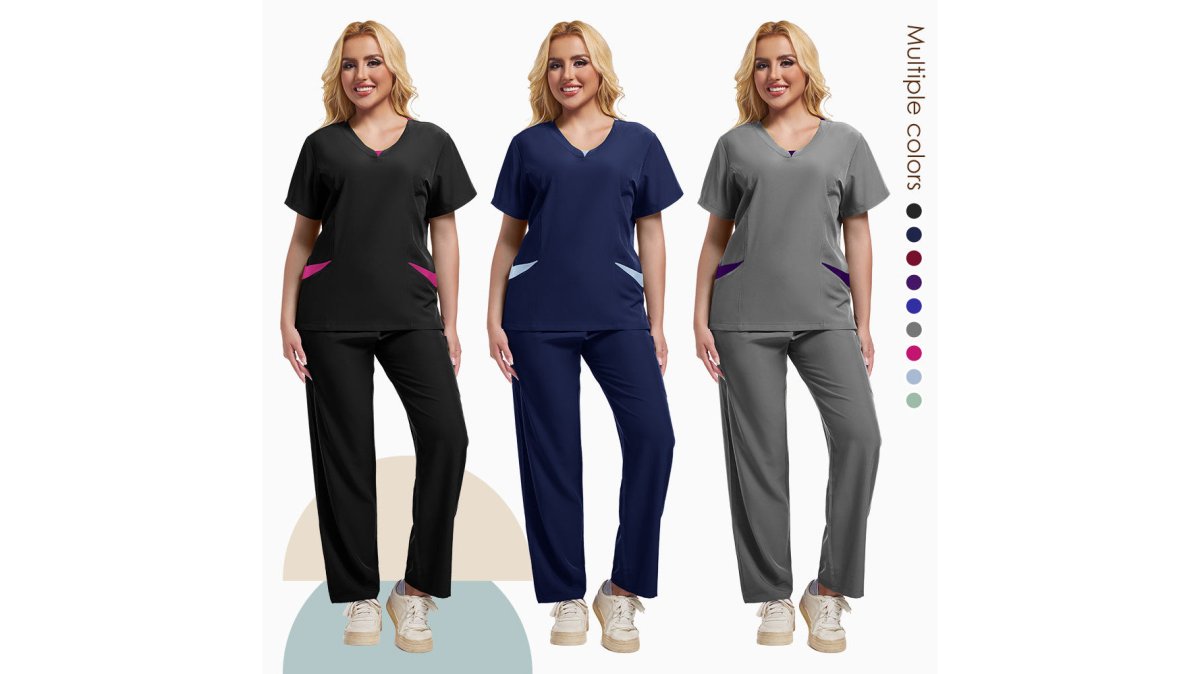
2. Stretchy, Quick-drying Scrubs: Best Value for Everyday Wear
At $43.89, the Stretchy, Quick-drying Scrubs set delivers the same moisture-wicking function as the top pick for less. The full-length pants and short-sleeve top suit daily rotation, and the polyester blend handles repeated washing without losing shape quickly.

One practical note: sizing runs small compared to standard sizing. Order one size up if you are between sizes, and check the size chart before buying.
3. Four-Way-Stretch Scrub Set: Best for Maximum Mobility
Mobility is where the Four-Way-Stretch Scrub Set earns its $50.40 price. The four-way stretch fabric moves in every direction, helping when you crouch, lift, or reach overhead. Available in gray, black, green, and blue across S to XXXL.

The trade-off is cost: this is the priciest set here, and the stretch advantage only pays off if your role involves constant physical movement. For desk-adjacent work, a cheaper set does the same job.
4. Moisture Wicking Scrub Set: Best for Hot Clinical Settings
If you work in a warm environment, the Moisture Wicking Scrub Set at $37.65 is the practical choice. It comes in ten colors, including pink, lake blue, and navy, across S to XXL, and the polyester pulls sweat away from the skin.
The honest limitation: this set has less stretch than the four-way option. If flexibility matters more than breathability, spend the extra money elsewhere.
CDC guidance on healthcare worker safety and hygiene
5. Men's Quick-Drying Comfortable Stretchy Scrubs Set: Best Budget Pick
At $34.99, this is the lowest-priced set in the lineup, and it does not cut corners on function. The fabric is moisture-wicking and sweat-stain resistant, with twelve colors and full-length pants across S to XXL.
A common observation is that some scrubs may fail at the seams, not the fabric. It's advisable to check the stitching around the crotch and pockets when your set arrives. If it looks thin, reinforcing it before the first wash can be beneficial.
6. Men's V-neck Lightweight And Breathable Scrubs: Best for Breathability
The Men's V-neck Lightweight And Breathable Scrubs set at $35.96 prioritizes airflow. The lightweight polyester keeps you cool, and the V-neck adds ventilation around the chest. Ten colors are available, from sapphire blue to deep burgundy, in S through XXL.
The one drawback is that lightweight fabric shows wrinkles more easily than heavier blends. If you need a crisp, pressed look, a denser fabric serves you better.
How to Care for Nursing Scrubs So They Last
Most care guides recommend washing cold and air-drying. This advice is generally correct, and understanding the underlying mechanisms can help extend the life of a scrub set. Here is information on common wear and tear, plus a wash-test framework you can consider.
What actually breaks down in a scrub
Four failure modes account for almost every "these scrubs died on me" complaint:
- Elastic fatigue. Spandex (elastane) is a polyurethane copolymer. Heat and chlorine accelerate hydrolysis of the urethane bonds, so the fiber loses its snap, why a set that felt supportive at month two feels baggy at month eight. Cold water and air-drying slow this; a hot dryer and bleach speed it up dramatically.
- Pilling. Short fibers work loose from the yarn and tangle into pills, worst where fabric rubs against itself, under the arms, along the inner thigh, and at the waistband. Washing inside out reduces that abrasion.
- Fading. Dye loss comes from mechanical abrasion and chemical attack. Chlorine bleach is the most destructive thing you can put on a colored synthetic; oxygen-based (color-safe) bleach is far gentler if you need to sanitize.
- Seam failure. Thread and stitch density matter more than fabric weight. A bar-tacked stress point at the crotch and pocket corners will outlast a plain straight stitch by a wide margin.
A 50-wash test you can run yourself
To assess durability, consider purchasing two identical sets, keeping one as a control, and washing the other multiple times on your normal cycle, then comparing them at these checkpoints:
- Wash 10: Check for color shift against the control. Any visible difference this early is a red flag.
- Wash 25: Look at the underarm and inner-thigh panels for pilling. Light fuzz is normal; matted pills are not.
- Wash 50: Test stretch recovery by pulling the waistband and releasing it. If it does not snap back within a second or two, the elastic is fatigued. Check every seam for fraying, especially the crotch gusset and pocket bar tacks.
A well-constructed polyester-spandex blend often shows only minor pilling and minimal color shift after many washes, while some sets with thin stitching may show seam separation earlier.
The care routine that actually extends lifespan
- Turn garments inside out before washing to reduce surface abrasion
- Use cold water (below 86°F) and a mild, enzyme-free detergent
- Skip chlorine bleach entirely; use oxygen-based bleach if sanitizing is required
- Skip fabric softener, it coats the fiber and blocks moisture wicking
- Air-dry, or use the lowest heat setting if you must tumble
- Inspect seams monthly and reinforce any bar tacks that look thin
How long should a set actually last?
With appropriate care, a polyester-spandex set worn regularly can maintain its color and fit for an extended period before showing signs of wear. Heavier-weight fabrics and reinforced stitching may offer even longer durability, while some cotton-rich blends might show fading and shrinking sooner.
The takeaway: the fabric you buy sets the ceiling, and the care routine decides how close you get to it.
Best Scrub Fabric for Durability
Polyester and polyester-spandex blends are the best fabric for durability in medical scrubs. Polyester resists pilling and fading, holds its shape through repeated washing, and dries quickly. A small spandex percentage, often around 5%, adds the stretch that keeps the fabric from feeling stiff.
Cotton feels softer at first but wrinkles, shrinks, and fades faster under heavy laundering. For healthcare uniforms worn multiple times a week, synthetic blends win on lifespan.
American Nurses Association resources on workplace safety
Sizing and Fit Considerations for Medical Professionals
Fit is not one-size-fits-all, and standard size charts may not always accommodate every body type. A set that fits one individual perfectly might not suit another. Here is how to shop for your frame, plus the checkpoints that matter regardless of size.
The universal fit checkpoints
Before you worry about body type, verify these four things on any set you try:
- Waistband type: A covered elastic waistband with an internal drawstring stays put during bending and reaching. A drawstring-only waistband can dig in; an elastic-only waistband can roll. The combination is the most secure.
- Inseam length: Measure your actual inseam, then compare it to the brand's stated inseam, not the size label. A 30" inseam on a "regular" pair is common; tall and petite lines often run 33" and 27" respectively.
- Pocket depth and placement: Deep utility pockets should sit at or below the hip bone so a phone or stethoscope does not swing forward when you lean. Chest pockets should sit high enough that a pen does not poke you when you bend.
- Range of motion: Raise both arms overhead and squat. If the fabric pulls across the back or the pants ride up, size up or switch to a four-way stretch fabric.
Fit guidance by body type
Tall frames (5'9" and up). The two problems are short inseams and short torsos. Look for a tall line with a 33" or longer inseam, and check the top's body length, a top ending above the hip exposes your back every time you reach overhead. A longer tunic cut or curved hem solves this, and cuffed jogger-style pants prevent dragging if you cannot find the right inseam.
Petite frames (5'3" and under). Standard pants pool at the ankle and create a tripping hazard. Look for a petite line with a 27"-29" inseam, or plan to hem. A shorter top body prevents bunching at the hips, and petite-specific cuts narrow the shoulder width so tops do not slide off when you bend.
Plus-size frames (2XL and up). The most common complaint is that brands simply scale up a straight-size pattern, making shoulders too wide and the waist too narrow relative to the hip. Look for separate plus-size patterns with a higher waist-to-hip ratio and deeper armhole. Four-way stretch is especially valuable here, and check that the top's bust measurement, not just the size label, matches yours.
Athletic or broad-shouldered frames. Standard tops often bind across the chest and back. A raglan sleeve or a set with a higher spandex percentage (8-10%) gives more give through the shoulder. If you lift or reach frequently, prioritize four-way stretch over fabric weight.
How to measure before you buy
You need four numbers: bust, waist, hip, and inseam. Measure over the undergarments you wear to work, not street clothes, and compare each number to the brand's size chart individually, do not assume a medium bust means a medium hip. Many brands publish separate top and bottom charts, and mixing sizes is normal.
When in doubt, size up on the top and buy the correct inseam on the bottom. A slightly loose top is comfortable; pants that drag or ride up are a safety issue. And if you fall outside the standard size range, seek out brands that publish tall, petite, or true plus-size patterns rather than scaling a straight-size cut.
Frequently Asked Questions
What are the most comfortable scrubs for nurses?
The most comfortable nursing scrubs combine four-way stretch fabric, a flexible waistband, and moisture-wicking properties. Look for options like the New Stretch Quick-drying Medical Scrubs or the Four-Way-Stretch Scrub Set, which move with you during bending and reaching. Breathable polyester blends with spandex keep you cool and dry through 12-hour shifts.
What scrubs last the longest?
Scrubs made from high-quality polyester blends with reinforced stitching and fade-resistant dyes last longest. The New Stretch Quick-drying Medical Scrubs and the Stretchy, Quick-drying Scrubs both use durable construction that resists pilling and shrinking after repeated washes. Proper care, like cold-water washing and air drying, extends their life further.
How do I choose scrubs that won't fade or pill?
Choose scrubs with a high polyester content and a tight weave, which resist pilling and fading better than loose knits. Look for terms like fade-resistant and pilling-resistant in product descriptions. The Scrub Set Short Sleeve Quick Drying is a good example, made from 95% polyester and 5% spandex for durability and color retention.
How should I care for nursing scrubs to make them last?
Wash nursing scrubs in cold water with like colors, turn them inside out, and avoid fabric softener, which can clog moisture-wicking fibers. Tumble dry on low or hang to dry. For stains, treat promptly with a mild detergent. Following these steps helps maintain the best scrub fabric for durability and keeps colors vibrant.
Are there scrubs better than FIGS?
When considering scrubs, focus on fabric technology, fit, and care. The New Stretch Quick-drying Medical Scrubs, for example, provide four-way stretch, moisture-wicking fabric, and durable construction for $46.10.
Nurses and clinical staff deserve workwear that holds up shift after shift without costing a premium. love2wear_scrubs builds durable, breathable scrubs with a modern fit, moisture-wicking fabric, and easy-care construction designed for long hours. Browse the full collection and find your next set today.