

How to Measure for Scrubs: A Fit Guide
Table of Contents
- Why Proper Measurement Matters for Scrub Fit
- What You'll Need Before Measuring
- How to Measure Your Chest and Bust
- Measuring Your Waistline and Hip Circumference
- Measuring Inseam for Scrub Pants
- How Should Scrubs Fit: Loose vs. Tailored
- Using a Scrub Size Chart to Find Your Size
- Handling Borderline Sizing and Fabric Stretch
Last Updated: August 25, 2026
Why Proper Measurement Matters for Scrub Fit
Getting the right fit when you measure for scrubs is essential for anyone spending 10, 12, or 14 hours on their feet in a hospital, clinic, or operating room. Ill-fitting scrubs distract you, fabric that bunches at the waist, sleeves that catch on equipment, and pants that shift with every bend drain energy you need for patient care. Healthcare professionals working long shifts need scrubs that move with their body, stay in place during rapid movements, and maintain their shape through dozens of washes (the CDC). This guide walks you through exactly how to measure for scrubs so you get a fit that lasts through your entire shift.
What You'll Need Before Measuring
A soft fabric measuring tape is non-negotiable, it's flexible and won't distort your measurements the way rigid rulers will. Wear minimal, fitted clothing when you measure, ideally a t-shirt and fitted pants or leggings. Stand in front of a mirror if possible to keep the measuring tape level. Write down your measurements immediately so you have them when you're ready to order.
How to Measure Your Chest and Bust
Wrap your measuring tape around the fullest part of your chest, keeping it snug but not tight. You should be able to slide one finger under the tape comfortably. The tape should be level all the way around. Breathe normally as you take the measurement, don't suck in your stomach or puff out your chest. Write down the number exactly as it appears on the tape.

If you're between sizes, fabric stretch becomes critical. Many scrub fabrics include spandex or elastane, which means they have built-in give. Love2wear_scrubs' polyester-blend scrubs include moisture-wicking properties and stretch that accommodates natural body movement, which is especially important if your chest measurement falls between standard sizes. Measure your chest as you'll actually be wearing it under scrubs, not with compression gear that distorts your actual measurement.

Measuring Your Waistline and Hip Circumference
Find your natural waistline, the narrowest part of your torso where you naturally bend when you lean to the side. Wrap the measuring tape around this point, keeping it level and snug but not tight. Don't pull tight; this is where people often make their biggest mistake. A tight waistline measurement leads to ordering pants that are too small and feel restrictive during long shifts.
Your hip circumference is equally important, especially if you have a pear-shaped body. Measure around the fullest part of your hips and buttocks, keeping the tape level. For most people, this is about 8-10 inches below the waistline. If your waist and hip measurements are significantly different, consider unisex or straight-cut scrubs rather than fitted styles. Love2wear_scrubs' V-neck, straight-cut scrub sets are engineered for this exact situation, offering a modern fit without the tapered waistline that can feel restrictive.

Measuring Inseam for Scrub Pants
Stand barefoot with your feet hip-width apart. Have someone measure from your center back neck seam straight down your spine to your ankle bone. If you're measuring yourself, use a flexible measuring tape and measure from the center back of your neck down to your ankle. The center back neck to ankle method is more standardized than measuring from the crotch seam and translates better across different brands.
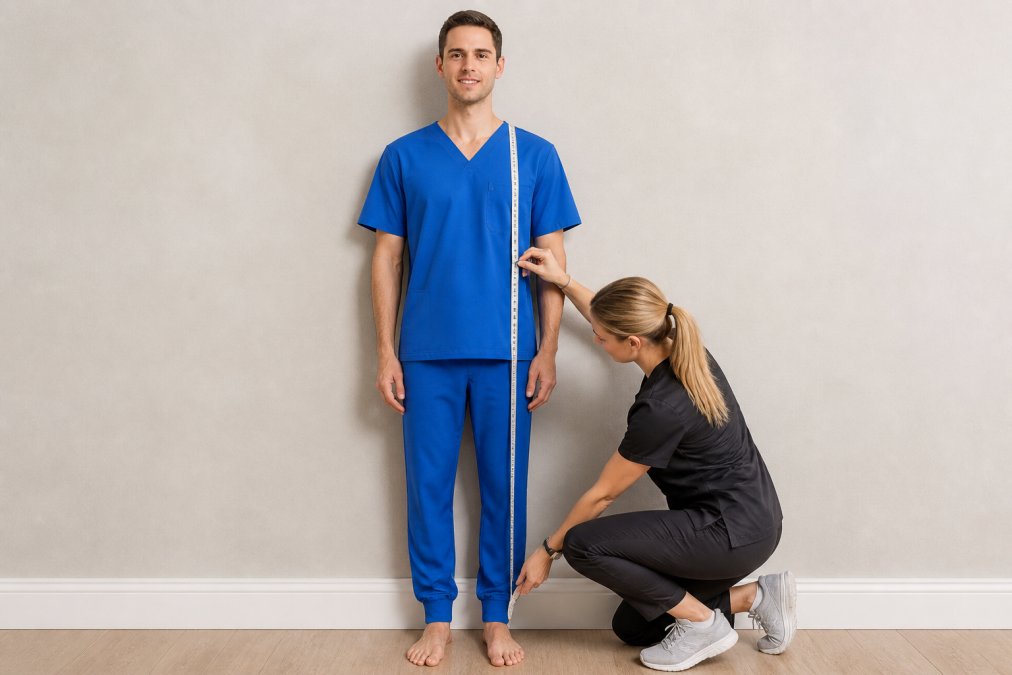
Write down this number carefully. Inseam length is typically listed in inches, and even a one-inch difference is noticeable when you're wearing scrubs all day. If you're between sizes, choose the slightly longer option because scrubs often shrink a bit in the wash, and you can always have them hemmed if needed.
How Should Scrubs Fit: Loose vs. Tailored
A loose, roomy fit gives you maximum freedom of movement during long shifts and is popular in emergency departments and operating rooms. Loose-fit scrubs don't cling to your body, which many healthcare professionals prefer for comfort and professionalism.
A tailored fit is more form-fitting and creates a modern, professional appearance. Tailored scrubs follow your body's contours more closely, but they require a more precise fit. If your measurements fall between sizes, a tailored fit may feel too tight or too loose.
For most healthcare professionals working long shifts, a loose or semi-fitted style is more practical. Love2wear_scrubs' straight-cut design offers a modern fit that's neither too tight nor too loose, giving you the professional appearance of a tailored garment without the restrictive feeling that becomes uncomfortable over a 12-hour shift. Body type matters too, if you have a larger chest or significant hip-to-waist variation, a looser fit accommodates your shape better than a tailored one.
Using a Scrub Size Chart to Find Your Size
A size chart is your most reliable tool for converting measurements into actual sizes. Every brand's sizing is slightly different, so never assume your usual clothing size translates to scrubs. Most scrub size charts use chest measurement as the primary sizing metric, with waist and hip as secondary guides.
| Size | Chest (inches) | Waist (inches) | Hip (inches) | Inseam (inches) |
|---|---|---|---|---|
| XS | 32-34 | 26-28 | 36-38 | 30, 32 |
| S | 34-36 | 28-30 | 38-40 | 30, 32, 34 |
| M | 36-38 | 30-32 | 40-42 | 32, 34, 36 |
| L | 38-40 | 32-34 | 42-44 | 34, 36, 38 |
| XL | 40-42 | 34-36 | 44-46 | 36, 38, 40 |
| XXL | 42-44 | 36-38 | 46-48 | 38, 40 |
If your measurements fall neatly into one size across all categories, order that size with confidence. Most people find their measurements span multiple sizes. When this happens, prioritize the chest measurement, a scrub top that's too loose in the chest looks sloppy. A scrub top that's slightly roomy at the waist is far more forgivable; you can cinch the waistband with the drawstring. For pants, prioritize the hip measurement if your hips are larger than your waist.
Handling Borderline Sizing and Fabric Stretch
Borderline sizing, when your measurements fall between two standard sizes, is frustrating. Scrubs made from 100% polyester have minimal stretch and require more precise sizing. If you're between sizes with a non-stretch fabric, slightly loose is usually the better choice for comfort during long shifts.
Fabrics with 5-10% spandex or elastane offer meaningful stretch (peer-reviewed research). This built-in give means you can confidently order a size that's slightly snug on paper, knowing the fabric will stretch to accommodate your body. Love2wear_scrubs' polyester-blend scrubs include stretch properties that adapt to your movements, which is especially valuable if you're a borderline size. The stretch also means the scrubs maintain their shape better through repeated washing.
When you're between sizes, consider your activity level. If you're constantly moving, bending, and reaching, opt for the larger size. Fabric weight also affects how sizing feels, heavier fabrics feel more structured and may fit more snugly, while lighter fabrics drape more loosely. Some fabrics shrink more than others; polyester shrinks minimally, but blends with cotton content can shrink 3-5% in the wash (peer-reviewed research). Love2wear_scrubs' all-polyester construction minimizes shrinkage, which means your measurements today will translate accurately to fit for months of wearing and washing.
Getting the right fit when you measure for scrubs transforms how you experience your workday. Scrubs that fit properly stay in place, move with you, and maintain their appearance through long shifts and repeated washing. Love2wear_scrubs' modern-fit designs are engineered for healthcare professionals who need durability, breathability, and comfort. Start with accurate measurements using the steps in this guide, consult the size chart carefully, and choose scrubs designed for the demands of your work.
=== FAQ ANSWERS (audit these too, same rules) ===
[1] Q: How do I know what size scrubs to buy if I'm between two sizes? A: When you're borderline between sizes, consider your body type and how scrubs should fit for your work style. If you prefer a looser, roomy fit for maximum movement during 12-hour shifts, size up. If you prefer a tailored fit with less fabric, size down. Check the scrub size chart for the specific brand, many modern scrubs account for fabric stretch, which affects how they'll fit after washing. Love2wear Scrubs' polyester-blend fabric offers moisture-wicking properties and maintains its shape, so sizing based on your natural waistline and shoulder width will give you the most accurate fit.
[2] Q: Should I measure over my clothes when taking body measurements for scrubs? A: No, measure directly against your skin or over thin, fitted clothing only. Measuring over heavy layers, sweaters, or loose clothing will give you inaccurate measurements and result in scrubs that are too large. Stand relaxed in front of a mirror, wear minimal undergarments, and have someone help if possible. This ensures your measurements reflect your actual body dimensions, not added bulk. Accurate self-measurement is the foundation for getting scrubs that won't ride up, shift around, or feel baggy during active patient care.
[3] Q: What is the most important body measurement for scrub tops? A: Your chest or bust measurement is the primary dimension for scrub tops. Measure across the fullest part of your chest with the measuring tape parallel to the ground and snug but not tight. This measurement determines the width and shoulder fit of the top. For scrub tops, you also want to note your shoulder width and sleeve length to ensure the garment allows full range of motion at the shoulder blades, critical for reaching, lifting, and bending during long shifts. A proper fit at the chest prevents the top from bunching or riding up.
[4] Q: How do I measure my inseam to ensure scrub pants have the right finished hem length? A: Stand barefoot with your feet shoulder-width apart and your back against a wall. Have someone measure from your center back neck seam straight down the inside of your leg to your ankle bone, or measure from your natural waistline down to your ankle. This inseam measurement determines the finished hem length of your scrub pants. Most scrub pants should have a finished hem that sits just above your shoe, covering your ankle without bunching at the hem. If your inseam falls between sizes on the scrub size chart, consider the rise of the pants, higher rise may require a slightly shorter inseam to maintain proper hem length.
Frequently Asked Questions
How do I know what size scrubs to buy if I'm between two sizes?
When you're borderline between sizes, consider your body type and how scrubs should fit for your work style. If you prefer a looser, roomy fit for maximum movement during 12-hour shifts, size up. If you prefer a tailored fit with less fabric, size down. Check the scrub size chart for the specific brand, many modern scrubs account for fabric stretch, which affects how they'll fit after washing. Love2wear Scrubs' polyester-blend fabric offers moisture-wicking properties and maintains its shape, so sizing based on your natural waistline and shoulder width will give you the most accurate fit.
Should I measure over my clothes when taking body measurements for scrubs?
No, measure directly against your skin or over thin, fitted clothing only. Measuring over heavy layers, sweaters, or loose clothing will give you inaccurate measurements and result in scrubs that are too large. Stand relaxed in front of a mirror, wear minimal undergarments, and have someone help if possible. This ensures your measurements reflect your actual body dimensions, not added bulk. Accurate self-measurement is the foundation for getting scrubs that won't ride up, shift around, or feel baggy during active patient care.
What is the most important body measurement for scrub tops?
Your chest or bust measurement is the primary dimension for scrub tops. Measure across the fullest part of your chest with the measuring tape parallel to the ground and snug but not tight. This measurement determines the width and shoulder fit of the top. For scrub tops, you also want to note your shoulder width and sleeve length to ensure the garment allows full range of motion at the shoulder blades, critical for reaching, lifting, and bending during long shifts. A proper fit at the chest prevents the top from bunching or riding up.
How do I measure my inseam to ensure scrub pants have the right finished hem length?
Stand barefoot with your feet shoulder-width apart and your back against a wall. Have someone measure from your center back neck seam straight down the inside of your leg to your ankle bone, or measure from your natural waistline down to your ankle. This inseam measurement determines the finished hem length of your scrub pants. Most scrub pants should have a finished hem that sits just above your shoe, covering your ankle without bunching at the hem. If your inseam falls between sizes on the scrub size chart, consider the rise of the pants, higher rise may require a slightly shorter inseam to maintain proper hem length.
This article was written using GrandRanker