

How to Find Stretchy Scrubs for Physical Therapists
Table of Contents
- Why Physical Therapists Need Stretchy Scrubs
- Key Features to Look for in Stretchy Scrubs
- Fit Types: Athletic vs. Modern vs. Traditional
- Best Scrubs for Movement: Jogger-Style vs. Straight-Leg
- How to Test Stretchy Scrubs for Your Workday
- Modern Fit Scrubs for Women: Sizing for Motion
- Caring for Stretchy Scrubs to Extend Their Life
- Final Tips for Choosing Your Next Pair
- Frequently Asked Questions
Last Updated: September 9, 2026
Why Physical Therapists Need Stretchy Scrubs
Physical therapy is not a desk job. You spend entire shifts squatting, pivoting during transfers, reaching for equipment, and demonstrating exercises on the floor. Standard cotton scrubs restrict that movement and bind across the shoulders and thighs. Finding the right stretchy scrubs for physical therapists is about protecting your body from the repetitive strain of clinical work.

Most medical uniforms are cut for standing and walking, not for the deep ranges of motion PT requires. When fabric lacks give, your joints compensate, leading to lower back tension and shoulder fatigue by the end of a 12-hour shift. We understand what active clinicians need, and the answer comes back to fabric engineering and smart construction rather than just style.
Below, we'll walk through the specific features that matter and how to test a pair before you commit. Stretchy scrubs are the difference between a uniform you tolerate and one that actively supports your clinical work.
Key Features to Look for in Stretchy Scrubs
The best stretchy scrubs combine a performance fabric with construction details that allow unrestricted movement. You want a four-way stretch material that moves with your body in every direction, not just a fabric that stretches lengthwise. Look for breathable mesh panels in high-heat zones and a tapered fit that won't snag on equipment or patients.
Fabric Composition: Spandex and Elastane Blends
The fabric composition determines everything about how a scrub performs during patient transfers and clinical mobility tasks. A polyester base with spandex or elastane added provides the recovery you need, meaning the fabric snaps back to its original shape after you stretch it (peer-reviewed research). Many high-activity roles benefit from a spandex blend of at least 5 to 10 percent for adequate flexibility without sacrificing durability (peer-reviewed research).
Pure cotton or high-cotton blends are the enemy of movement. They absorb sweat, dry slowly, and lose their shape after repeated industrial laundry cycles. Performance fabric with moisture-wicking properties keeps you dry during back-to-back sessions, and the polyester base resists the fading and shrinkage that ruins cotton uniforms within months.
Construction: Gusseted Crotch and Reinforced Seams
Fabric matters, but construction is what holds up under real pressure. A gusseted crotch adds fabric at the seam intersection, giving you extra room for deep squats and lunges without the seam pulling or tearing. Reinforced seams, particularly along the inner leg and shoulder, prevent the blowouts that happen when you're constantly bending and reaching.
Fit Types: Athletic vs. Modern vs. Traditional
Scrub fits fall into three main categories, but the differences go beyond how they look on a hanger. For physical therapists, the right fit is the difference between a uniform that moves with you and one that fights you during a transfer or a floor exercise. Here’s how each cut behaves in motion, not just in the dressing room.
Traditional Fit: Room to Move, but at a Cost
Traditional scrubs are cut boxy and loose, giving unrestricted range of motion but creating other problems. The excess fabric can catch on treatment table edges, wheelchair armrests, or gait belt hardware. When demonstrating a lunge or squat, baggy legs can ride up or bunch behind your knees, distracting and throwing off your form. The loose fit also looks less professional in settings where patients expect a polished appearance.
Modern Fit: The Balanced Middle Ground
Modern fit is tailored closer to the body than traditional but not as snug as athletic, featuring a slight taper through the leg and a more defined waist. This works well for PTs who want a professional look without feeling restricted. However, a modern fit that is too narrow in the seat will bind when you squat or lunge. Look for modern-fit pants with a gusseted crotch or extra room in the hip area, some brands offer a “modern athletic” cut that combines clean lines with mobility.
Athletic Fit: Designed for Motion
Athletic fit is cut closer to the body, with tapered legs and more room through the shoulders and upper back. This is the go-to for PTs because it’s designed for people who move constantly, reducing fabric bunching and keeping the pant leg out from underfoot. But athletic fit assumes a certain body shape, typically a straighter torso and narrower hips. If you have a curvier build, a fit that’s too tight through the glutes will pull across the seam when you bend, and a snug waistband can dig in during a 12-hour shift.
How to Choose Based on Your Body and Movement Patterns
Instead of picking a fit by name, evaluate how the cut interacts with your body mechanics:
- For deep squats and lunges: Look for a fit that gives you at least 2-3 inches of extra fabric in the seat and thigh when you’re in a crouched position. If the fabric feels taut over the glutes, the cut is too narrow.
- For overhead reaches and shoulder mobility: Athletic and modern fits often have raglan sleeves or underarm gussets that allow full arm extension. Traditional fits may have set-in sleeves that pull across the back when you raise your arms.
- For patient transfers: The waistband is critical. A drawstring or elastic waistband that sits at your natural waist will stay put when you’re lifting. A low-rise cut can shift down when you bend, which is both uncomfortable and a safety hazard.
The Squat Test for Fit Types
You can’t judge a fit by how it looks standing still. Use this quick test in the dressing room:
- Squat down as if you’re picking up a patient’s dropped item. Notice if the waistband gaps at the back or if the fabric pulls across the hips.
- Lunge forward with one knee on the floor. Check that the crotch seam doesn’t dig in and that the leg doesn’t ride up.
- Reach overhead with both arms. Feel for any binding across the shoulders or upper back.
If the fit fails any of these, move to a different size or cut. Many brands now offer “athletic” and “modern” in the same garment, so you can get the mobility of athletic with a more polished look.
Best Scrubs for Movement: Jogger-Style vs. Straight-Leg
Jogger-style scrub pants have become the default choice for active clinicians, and for good reason. The elastic waistband with drawstring closure keeps pants secure during bending and squatting, while the tapered ankle prevents the fabric from dragging on the floor or catching under your feet. Utility pockets sit flat against the thigh, so your phone and scissors don't swing into your way.
Straight-leg pants still have their place, particularly in settings where a more formal appearance matters. But they require careful hemming to avoid pooling at the ankle, and the wider leg opening can ride up when you're kneeling. For physical therapists who need best scrubs for movement, jogger-style pants are the practical choice because they stay put through the most demanding parts of your shift.
How to Test Stretchy Scrubs for Your Workday
You cannot judge a scrub's performance by looking at it on a hanger. The only reliable method is to put the garment through the same movements you perform at work. A common mistake is buying based on how the fabric feels in your hand, then discovering the fit fails during an actual shift.
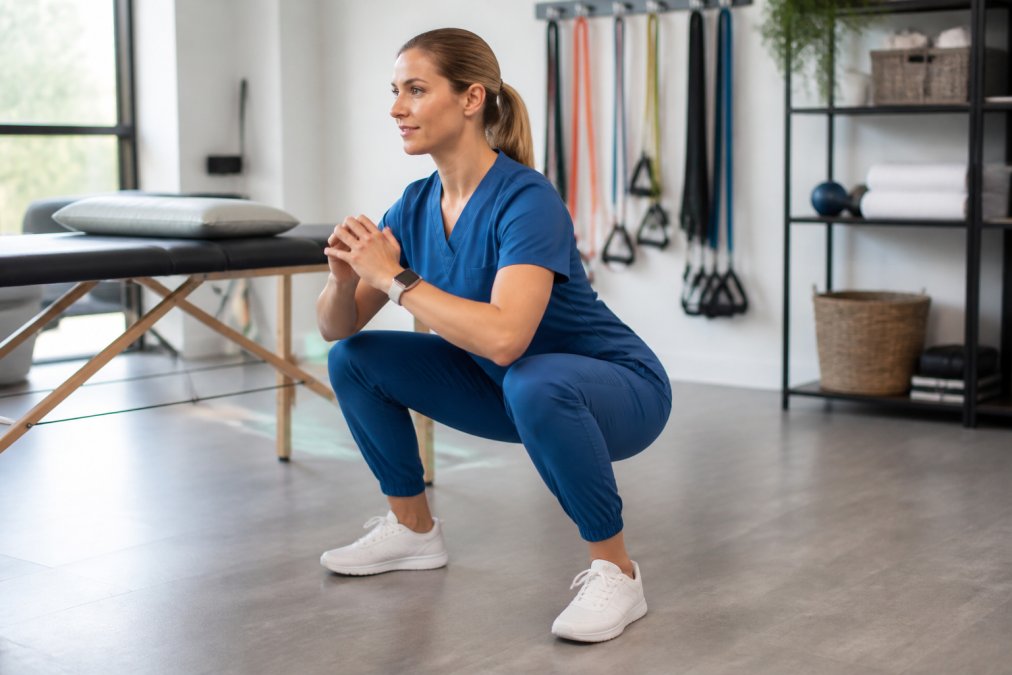
The Squat Test
Put the scrubs on and lower yourself into a full deep squat with your heels flat on the floor. Hold for 30 seconds. If you feel binding across the thighs, pulling at the crotch seam, or the waistband digging into your abdomen, the fit is wrong. The fabric should stretch with you and return to its original shape when you stand.
Repeat with a forward lunge and an overhead reach. These three movements cover the majority of positions you'll use during a typical treatment session. If the scrubs pass all three without restriction, they will likely handle your clinical day.
Checking Recovery and Shrinkage Resistance
Fabric recovery is how well the material bounces back after being stretched. Poor recovery means the knees and elbows bag out by midday. To test this, stretch the fabric at the knee, hold for ten seconds, then release. Quality four-way stretch material should snap back immediately without visible distortion.
Shrinkage resistance matters just as much. Cotton shrinks and warps in hot water and industrial dryers, which is why many clinicians report their scrubs fitting differently after just a few washes. Polyester-based performance fabrics hold their dimensions through repeated laundering.
Modern Fit Scrubs for Women: Sizing for Motion
Modern fit scrubs for women offer a tailored silhouette without the restriction of a skinny cut. But women’s bodies vary widely in hip-to-waist ratio, thigh circumference, and torso length. A scrub that fits perfectly on a straight-frame clinician can bind on a curvier one. Here’s how to evaluate sizing for your body type.
Understanding Hip-to-Waist Ratio
Most women’s scrub pants are cut with a waist-to-hip difference of about 8-10 inches. If your difference is larger, say 12 inches or more, a size that fits your waist may be too tight through the hips, and a size that fits your hips gaps at the waist. Look for pants with a drawstring that cinches without bunching, or consider a “curvy” fit that adds room in the hip and thigh while keeping the waist narrower.
Thigh and Seat Room for Squats and Transfers
During patient transfers, you’re often in a deep squat or a wide stance. If the pants are too tight through the thigh, the fabric pulls across the quadriceps and the crotch seam digs in. A good test is to sit in a chair with your knees apart, as if bracing for a transfer. If the fabric feels taut over the thighs or seat, size up or look for a style with a gusseted crotch.
Torso Length and Waistband Placement
Women’s scrub tops and pants are often cut for an average torso length. If you have a longer torso, a standard rise may sit too low, causing the waistband to slide down when you bend. If you have a shorter torso, a high-rise waistband may hit an uncomfortable spot. Check the rise measurement (from crotch to waistband) when trying on pants. A rise of 9-10 inches is typical for mid-rise; high-rise is 10-11 inches. Choose a rise that keeps the waistband at your natural waist.
Sizing Up vs. Altering
If you’re between sizes, it’s often better to size up and have the waist taken in than to squeeze into a smaller size that restricts movement. A tailor can take in the waist of scrub pants for about $15-$20. Alternatively, look for brands that offer petite and tall lengths, which adjust the inseam without changing the hip or waist proportions.
The Overhead Reach and Twist Test
When you try on modern fit scrubs, don’t just stand in front of the mirror. Perform these movements:
- Overhead reach: Raise both arms as if you’re reaching for a high shelf. The top should not ride up or pull across the chest.
- Torso twist: Twist your upper body to the left and right, as if you’re turning to grab a tool from a cart. The fabric should not bind across the back.
- Forward bend: Bend at the waist as if you’re picking up a patient’s foot. The waistband should stay in place, and the pants should not gap at the back.
If any of these movements cause the fabric to pull or shift, the fit is not right for your body mechanics.
Caring for Stretchy Scrubs to Extend Their Life
Even the best stretchy scrubs will fail early if you launder them incorrectly. High heat is the primary culprit. Hot water and high dryer settings break down elastane fibers, causing the fabric to lose its stretch and become baggy (clemson.edu). Wash your scrubs in cold or warm water and dry them on low heat or hang them to dry.
Avoid fabric softeners, which coat synthetic fibers and reduce moisture-wicking properties over time. Skip the bleach unless dealing with a genuine biohazard situation, as chlorine degrades both polyester and spandex. A gentle cycle with a sports detergent designed for performance fabrics keeps the material functioning at its best.
Final Tips for Choosing Your Next Pair
Finding the right stretchy scrubs for physical therapists comes down to prioritizing function over fashion. Choose a four-way stretch polyester blend with moisture-wicking properties, look for gusseted crotches and reinforced seams, and pick a jogger-style cut that stays secure through patient transfers. Test the fit with movements that mirror your actual work, and launder the garment properly to protect the elastane fibers.
| Selection Factor | What to Look For | Why It Matters |
|---|---|---|
| Fabric | Polyester with 5-10% spandex or elastane | Provides four-way stretch and shape recovery |
| Construction | Gusseted crotch, reinforced seams | Prevents blowouts during squats and transfers |
| Fit | Athletic or modern, tapered leg | Reduces snagging and fabric bunching |
| Waistband | Elastic with drawstring | Keeps pants secure during bending |
| Care | Cold wash, low heat dry | Protects elastane and extends garment life |
The Four-Way-Stretch Scrub Set from love2wear_scrubs combines a polyester four-way stretch fabric with moisture-wicking function, giving you the range of motion your work demands without the premium price tag. The Stretchy, Quick-drying Scrubs offer a similar performance profile for clinicians who prioritize sweat resistance during active sessions, while the Mens Quick-Drying Comfortable Stretchy Scrubs Set delivers the same fabric technology at an accessible price point.


A scrub that restricts your movement is not just uncomfortable, it's a liability during patient care. The right pair supports your body mechanics, survives repeated industrial laundering, and lets you focus entirely on your patients rather than adjusting your uniform. Quality workwear without the premium price is possible when you choose performance fabrics over traditional cotton.
Frequently Asked Questions
What material makes scrubs stretchy?
Stretchy scrubs almost always contain spandex or elastane blended with polyester. A four-way stretch fabric with around 5-10% spandex gives the best flexibility for physical therapists. These materials allow the fabric to expand and recover without losing shape, so you can bend, squat, and reach during patient transfers without feeling restricted or worrying about the fabric tearing.
How should physical therapy scrubs fit for maximum mobility?
Your scrubs should fit close without being tight. Look for a tapered or jogger-style pant that allows full knee flexion. The top should have enough room through the shoulders and back for reaching. Always perform a squat test when trying them on. If the fabric pulls across the thighs or back, size up or choose a style with a gusseted crotch.
Are joggers or straight-leg scrubs better for physical therapy?
Jogger-style scrub pants are generally better for physical therapists. The tapered leg with elastic cuffs stays out of the way during movement and prevents the hem from dragging on the floor during exercises or patient transfers. Straight-leg scrubs can bunch up or get caught underfoot. Joggers also offer a modern, athletic-inspired look that pairs well with the active nature of the job.
What scrubs do physical therapists wear?
Physical therapists wear scrubs made from performance fabrics with four-way stretch and moisture-wicking properties. They choose options like the Four-Way-Stretch Scrub Set or the Stretchy, Quick-drying Scrubs from love2wear. These provide the durability and flexibility needed for 12-hour shifts. Look for features like reinforced seams, deep utility pockets, and a drawstring closure for a secure fit during physical activity.
The challenge with stretchy scrubs is that you cannot judge them by looks alone. Fabric composition, seam construction, and fit all determine whether a pair survives the physical demands of physical therapy. Love2wear Scrubs builds durable, breathable, and comfortable uniforms with a modern fit, engineered for all-day comfort and easy care through long shifts. Get started with love2wear_scrubs and find workwear that moves with you during every patient transfer and treatment session.