

How to Measure for Scrub Fit: 2026 Sizing Guide
Table of Contents
- What You'll Need Before You Measure
- How to Measure for Scrub Fit: Step-by-Step Body Measurements
- How to Measure Inseam for Scrubs
- Using a Scrub Size Chart Effectively
- Fabric Stretch, Shrinkage, and How They Change Your Fit
- Comfortable Scrub Fit Tips for Long Shifts
- Frequently Asked Questions
Last Updated: September 11, 2026
What You'll Need Before You Measure
Getting scrub fit right starts with a flexible tape measure. A mirror, notebook, and well-fitting t-shirt make it faster and more accurate.
Scrubs that looked right online but pulled at the shoulders or gaped at the waist by hour six are a common frustration. The fix: measure your body, not your street size, then compare those numbers against a real size chart.
Gather these before you start:
- A soft tape measure (the kind used for sewing, not a metal contractor's tape)
- A full-length mirror, or a friend to help with hard-to-reach spots
- A fitted t-shirt and leggings or thin pants, not bulky clothing
- A notebook or phone to record each number
- Your current favorite scrub set, for comparison
Measure over light clothing, keep the tape snug but not tight, and stand naturally. Consistency matters more than perfection.
How to Measure for Scrub Fit: Step-by-Step Body Measurements
Learning how to measure for scrub fit comes down to three numbers: bust or chest, natural waist, and hip width. Getting all three right separates scrubs that move with you from scrubs that fight you all shift.
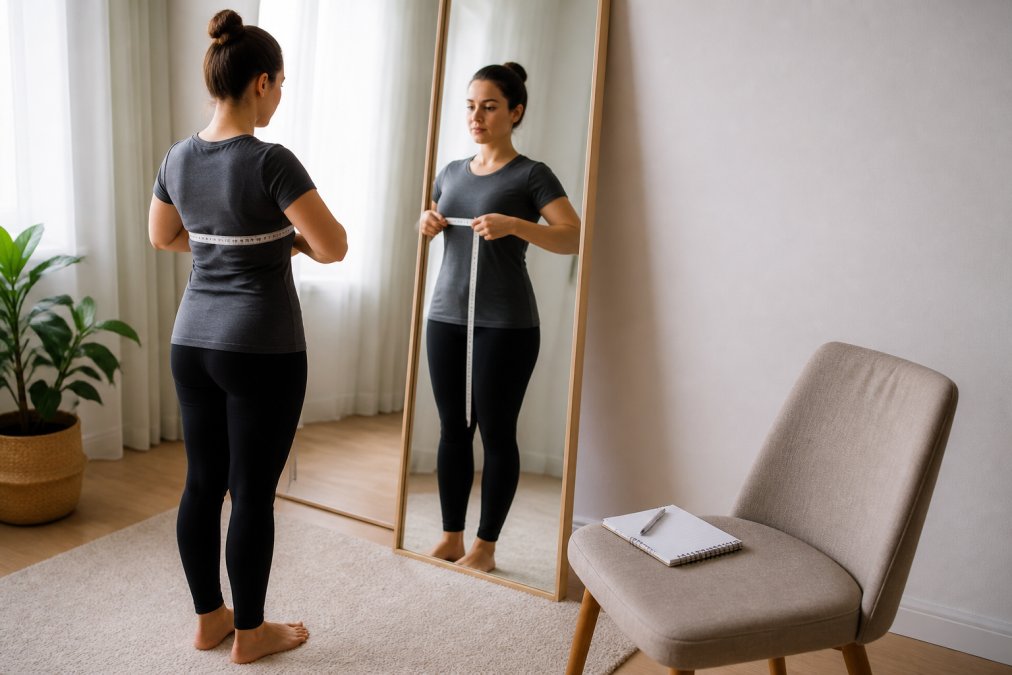
Measuring Your Bust or Chest
Wrap the tape around the fullest part of your bust or chest, keeping it level. For women, that's the bust at its widest point; for men, the fullest part of the chest, usually just under the armpits.
Keep the tape parallel to the floor. A tape that dips at the back reads smaller than your true size, a common mistake.
Finding Your Natural Waistline
Your natural waistline sits above your belly button and below your ribcage, at the narrowest point of your torso (the CDC). Bend slightly to one side; the crease that forms is your natural waist.
Breathe normally and avoid pulling the tape tight. A measurement taken while holding your breath produces scrubs that feel restrictive by mid-shift.
Determining Hip Width
Stand with feet together and wrap the tape around the widest part of your hips, usually across the pelvic bone and the fullest part of your seat. Keep it level and snug without compressing.
Hip width matters most for scrub pants: too small a measurement causes pulling across the seat and restricted range of motion when you bend or squat.
| Measurement | Where to Place the Tape | Common Mistake |
|---|---|---|
| Bust or chest | Fullest part, level all around | Tape dips at the back |
| Natural waistline | Narrowest point above the navel | Pulling tape too tight |
| Hip width | Widest point across pelvic bone | Measuring over bulky clothing |
How to Measure Inseam for Scrubs
Inseam is the distance from the crotch seam to the hem, and it's the measurement most people skip, which is why so many scrub pants drag on the floor or hit awkwardly above the ankle. Unlike bust, waist, and hip, inseam barely changes with weight fluctuation, so once you know your number you can reuse it across brands.
The most reliable method uses a pair of pants you already own that fit well in length. Lay them flat on a hard surface (not a bed, which lets fabric stretch and skew the reading), smooth the inner leg, and measure from the crotch seam straight down to the hem.
To measure on your body, stand barefoot with feet slightly apart and have someone measure from your crotch down the inside of your leg to the floor or desired hem. This is more accurate for tapered or slim-cut scrubs, since it captures how fabric drapes on your leg rather than how it lies flat.
Inseam by Body Type
Standard inseam lengths assume an average frame, which is why so many people end up hemming or returning scrub pants. Adjust for your build:
- Petite frames (generally under 5'4"): A regular inseam often runs 2-4 inches too long, bunching at the ankle and dragging under shoes. Look for petite sizing, plan on hemming, or choose a cropped/ankle-length cut.
- Tall frames (generally over 5'9"): Regular inseams often fall 1-3 inches short, leaving a gap above the shoe. Size up for length and have the waist taken in, or look for tall-specific lines, sizing up adds width through the hip and thigh, not just length.
- Plus-size frames: Inseam isn't tied to waist size, so measure it independently rather than assuming it scales with your waist. Many plus-size scrub lines offer multiple inseam options for this reason.
- Curvy or athletic builds: A larger seat or thicker thighs pulls the crotch seam lower than the flat-lay measurement suggests, shortening the effective inseam. With a pronounced seat-to-waist ratio, add roughly half an inch to compensate.
Choosing Your Hem Length
Decide upfront whether you want a hem that breaks slightly over the shoe or sits clean at the ankle. That preference changes which size you order:
- Full break: Hem rests on the top of the shoe with a slight fold. Common for traditional straight-cut scrubs.
- Slight break: Hem just touches the shoe. The most versatile option for clinical work.
- No break / ankle: Hem sits at or just above the ankle bone. Popular for jogger-style and tapered scrubs, and it keeps hems clear of spills and floors.
Outside leg length (waist to floor) is a useful backup if inseam is hard to pin down, especially when measuring alone. Write both numbers down so you can match a chart's "regular," "short," or "long" inseam directly instead of guessing.
Using a Scrub Size Chart Effectively
A scrub size chart converts your body measurements into a garment size, and it only works if you read it the way the manufacturer intended. Every brand builds its chart around its own fit blocks, so a medium in one line can measure like a small in another.
Here's how to use one properly:
- Take your three core measurements, plus inseam.
- Find your size on the chart for each measurement separately.
- If your numbers land on different sizes, size to the largest measurement for tops and consider your fit preference for pants.
- Check whether the chart lists garment dimensions or body measurements. They are not the same thing, and mixing them up is a frequent source of returns.
- Note the center back neck seam length if the chart provides it, since this affects how a top sits across the shoulders.
A body-measurement chart tells you what body the garment is cut for; a garment-dimension chart tells you the actual flat-lay size of the fabric. If a chart doesn't specify, treat it as body measurements.
Fabric Stretch, Shrinkage, and How They Change Your Fit
Fabric behavior is the part most sizing guides ignore, and it's why two people with identical measurements can need different sizes. Stretch percentage, weave, and post-wash shrinkage all shift how a scrub fits after a week of wear and washing, measuring your body and reading the chart only solves half the equation.
How Fabric Composition Affects Fit
Scrub fabric falls along a spectrum from rigid to highly elastic, and where it sits determines whether you size to your exact measurement or size down for a closer fit.
- 100% cotton: Minimal mechanical stretch. It holds a structured shape but has almost no give through the shoulders, hips, or knees. Size to your largest measurement with a little ease, there's no stretch to bail you out.
- Cotton-poly blends (roughly 60/40 or 65/35): The most common scrub fabric. Polyester adds durability and shape retention, cotton adds breathability. Stretch is modest, so size to your measurements.
- Polyester-spandex blends (typically 3-10% spandex): Noticeable four-way stretch through the shoulders, hips, and knees. Between sizes and wanting a closer fit? You can often size down. Prefer relaxed? Stay at your measured size.
- Performance knits and moisture-wicking polyesters: Often the stretchiest category, recovering shape well so a snug fit stays snug rather than bagging out over a shift.
Quick field test: pull a section of fabric gently. If it snaps back easily, it has good recovery and you can trust a closer fit. If it barely moves, size to your measurements with room to spare.
Post-Wash Shrinkage: What to Expect
Shrinkage is the silent size-changer: a scrub that fits perfectly in the fitting room can feel a half-size smaller after a few wash cycles, and the effect is largest in cotton-rich fabrics.
- Cotton-rich fabrics shrink most, especially in hot water or high-heat drying. Expect noticeable tightening in length and width after the first wash, with most change in the first one to three cycles.
- Polyester-dominant blends hold their dimensions much better. Shrinkage is minimal, which is why performance scrubs are popular for a predictable fit over the garment's life.
- Spandex blends resist shrinkage in the fabric itself, but elastic fibers degrade over many hot washes, so the garment loses recovery and feels looser over time.
Wash new scrubs in cold water and dry on low to limit shrinkage (energy.gov). Between sizes in a cotton-rich, low-stretch fabric? Size up. In a stretchy poly-spandex blend and wanting a closer fit? Stay at your measured size.
Stretch, Shrinkage, and the Size You Should Order
Combine the two factors into a single decision:
| Fabric Type | Stretch | Shrinkage Risk | If You're Between Sizes |
|---|---|---|---|
| 100% cotton | Low | High | Size up |
| Cotton-poly blend | Low to moderate | Moderate | Size up if cotton-dominant |
| Poly-spandex blend | High | Low | Stay at measured size, or size down for a closer fit |
| Performance knit | High | Low | Stay at measured size |
Comfortable Scrub Fit Tips for Long Shifts
Comfortable scrub fit tips come down to three things: room to move, fabric that breathes, and a cut that stays put. A 12-hour shift involves bending, reaching, lifting, and constant motion, and a fit that works for a five-minute try-on rarely works for a full day.
Start with range of motion. Raise your arms overhead, squat, and twist at the waist in the scrubs. If fabric pulls tight across the back or pants ride up, the size or cut is wrong for you.
Consider these adjustments:
- Choose a comfort allowance of roughly a finger's width of ease at the waist and chest for movement without bagginess.
- Prioritize breathable fabric if you run warm or work in a busy clinical environment.
- Check the rise on pants. A low rise can shift during bending, while a mid or high rise stays in place.
- Look for deep pockets if you carry a phone, scissors, or a stethoscope, since shallow pockets stretch and tear under load.
Body type matters too. A pear-shaped frame often needs a larger pant size than top size, while a broader-shouldered frame may size up in tops and keep pants at the measured size. Scrubs that fit each zone correctly beat a single "correct" size every time.
Sizing scrubs correctly is less about one magic number and more about measuring honestly, reading the chart carefully, and accounting for how fabric behaves over time. love2wear_scrubs delivers high-quality, professional medical apparel designed for the demanding needs of healthcare professionals. We provide durable, breathable, and comfortable scrubs with a modern fit, ensuring all-day comfort and easy care throughout long shifts, all without the premium price tag. Explore our V-neck straight-cut sets and scrub tops to find your size, then get started with love2wear_scrubs and wear scrubs that fit right from the first shift to the last.


Frequently Asked Questions
How do I figure out my scrub size?
Start by taking your bust, waist, hip, and inseam measurements using a soft tape measure. Compare those numbers to the scrub size chart for the brand you are buying. If your measurements fall between two sizes, size up for a looser scrub fit or size down if you prefer a tailored look and the fabric has stretch. Always check the specific chart because sizing varies by brand.
Do scrub sizes run big or small?
Scrub sizing is not standardized across brands, so it varies. Some brands cut generously while others run closer to street size. Use the brand's scrub size chart and your own measurements rather than assuming your usual size will fit. Reading reviews about how a specific style fits can also help you decide whether to size up or down.
How should scrub bottoms fit?
Scrub bottoms should sit at your natural waist or slightly below, with enough room to squat, bend, and move without the fabric pulling tight. The inseam should reach your desired length, and the leg should skim your thigh without clinging. If you can slide two fingers under the waistband and the pants stay in place when you walk, the fit is right.
How do I measure my inseam for scrub pants?
Wear the shoes you normally work in. Stand straight and have someone measure from the crotch seam of a pair of pants that fit you well down to the hem. Alternatively, measure from your pelvic bone to your ankle bone. Write down the number in inches. Compare it to the scrub size chart's inseam column to pick the right length.